
Data Centres...
Part 2

Part Two of our Alberta data centre series is here.
This time, we look at what the Town of Olds is teaching the rest of the province about evaluating major projects properly, why the relatively small permanent workforce at data centres tells only a fraction of the economic story, and whether Alberta's electrical grid can realistically support what's being proposed today.
And by the end of the episode, we ask you to help decide where this series goes next.
Transcripts:
The Power Bet, Part Two
Why Alberta actually competes for this investment, what Olds is teaching the rest of the province about evaluating major industrial projects, why modest employment numbers don’t tell the whole story, and whether Alberta can support what’s being proposed today. Plus, we’re asking you to help decide what comes next.
Today, we continue our deep dive into data centres, because this story has become much bigger than a single announcement. It's about energy. Infrastructure. Artificial intelligence. And perhaps most importantly, how Alberta decides whether its next major industry is worth building.
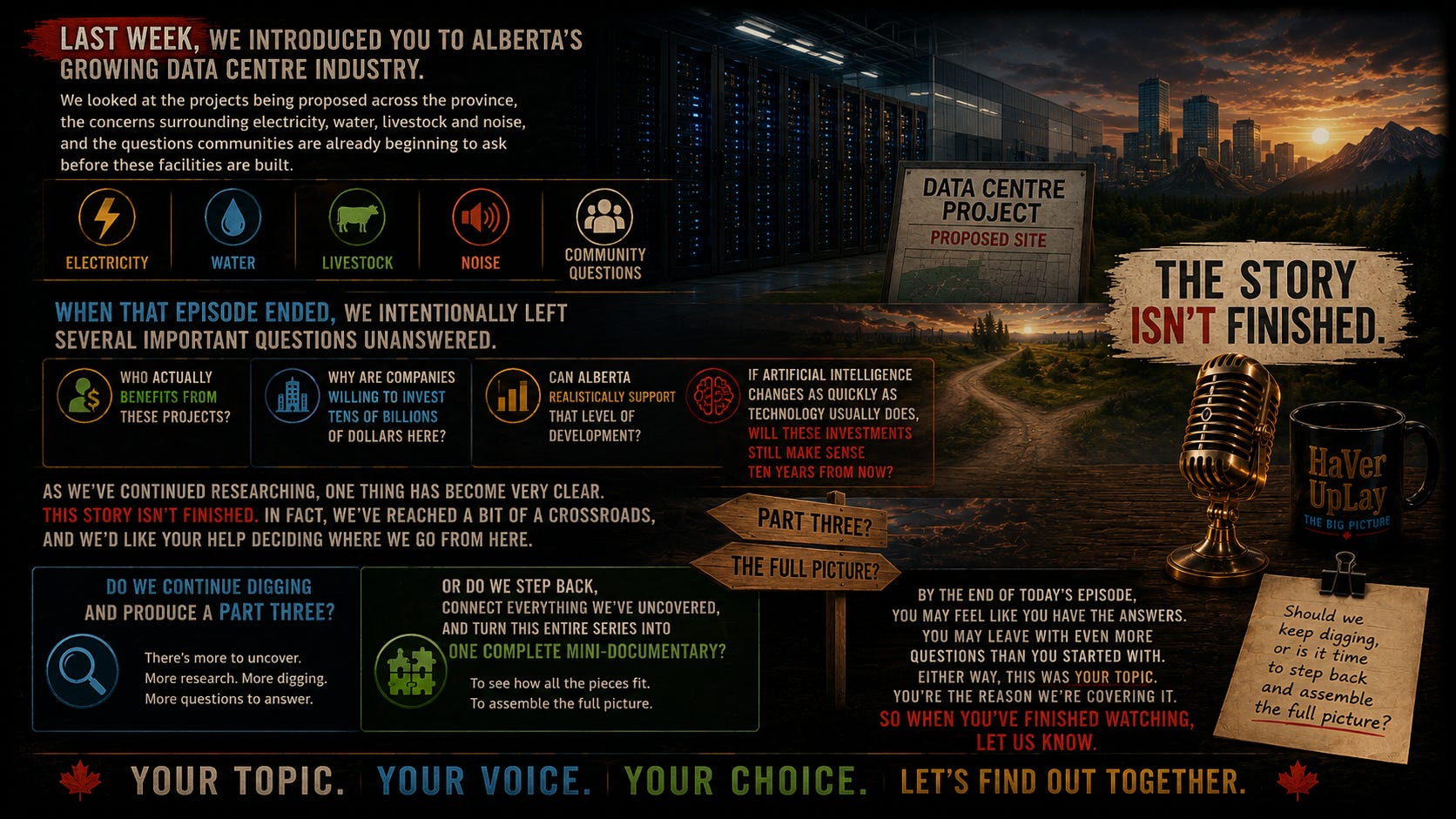
Last week, we introduced you to Alberta’s growing data centre industry. We looked at the projects being proposed across the province, the concerns surrounding electricity, water, livestock and noise, and the questions communities are already beginning to ask before these facilities are built.
When that episode ended, we intentionally left several important questions unanswered. Who actually benefits from these projects. Why are companies willing to invest tens of billions of dollars here. Can Alberta realistically support that level of development. And perhaps the biggest question of all, if artificial intelligence changes as quickly as technology usually does, will these investments still make sense 10 years from now.
As we’ve continued researching, one thing has become very clear. This story isn’t finished. In fact, we’ve reached a bit of a crossroads, and we’d like your help deciding where we go from here. Do we continue digging and produce a Part Three. Or do we step back, connect everything we’ve uncovered, and turn this entire series into one complete mini-documentary.
By the end of today’s episode, you may feel like you have the answers. You may leave with even more questions than you started with. Either way, this was your topic. You’re the reason we’re covering it. So when you’ve finished watching, let us know. Should we keep digging, or is it time to step back and assemble the full picture.
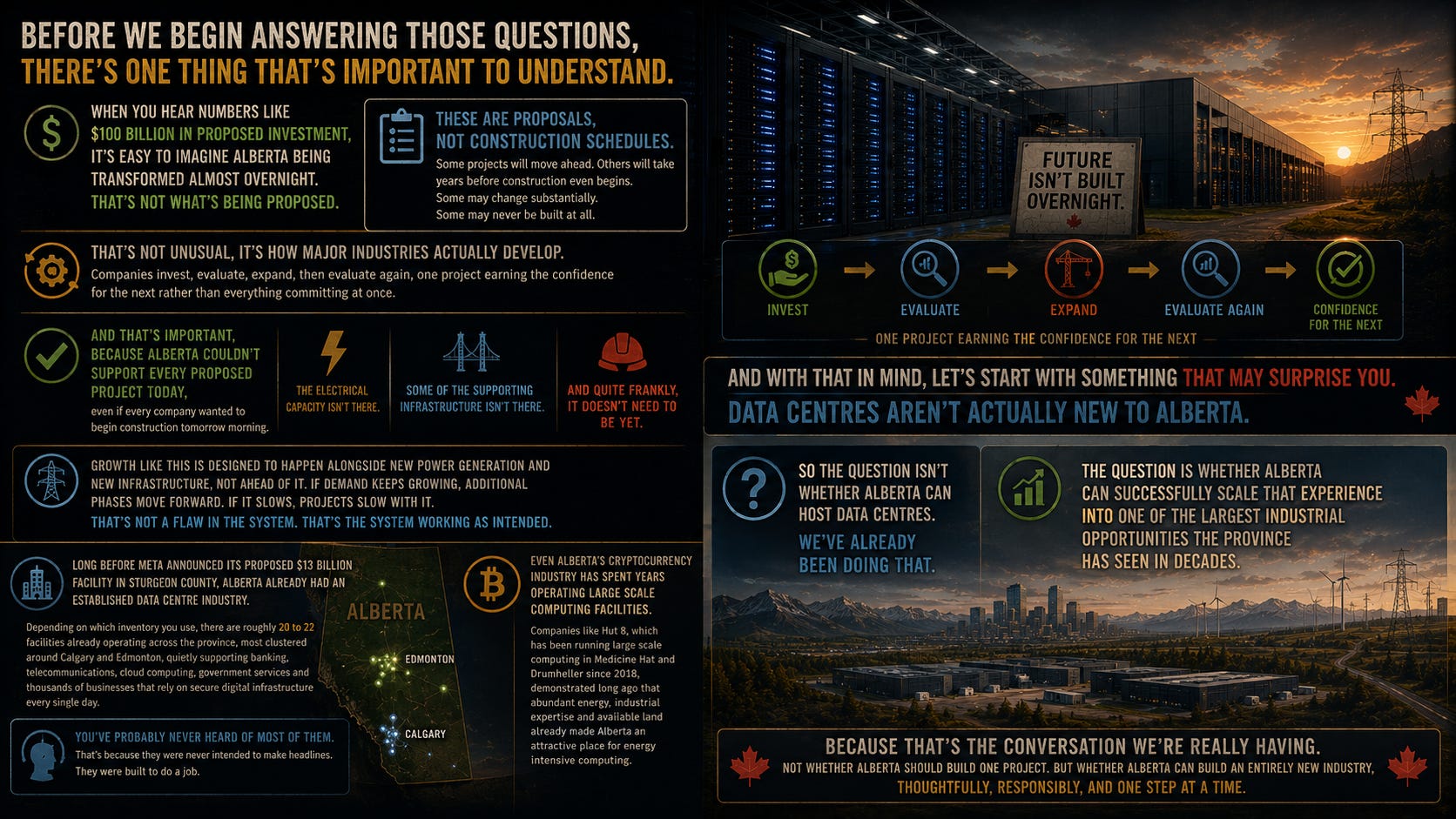
Before we begin answering those questions, there’s one thing that’s important to understand. When you hear numbers like $100 billion in proposed investment, it’s easy to imagine Alberta being transformed almost overnight. That’s not what’s being proposed.
These are proposals, not construction schedules. Some projects will move ahead. Others will take years before construction even begins. Some may change substantially. Some may never be built at all. That’s not unusual, it’s how major industries actually develop. Companies invest, evaluate, expand, then evaluate again, one project earning the confidence for the next rather than everything committing at once.
And that’s important, because Alberta couldn’t support every proposed project today, even if every company wanted to begin construction tomorrow morning. The electrical capacity isn’t there. Some of the supporting infrastructure isn’t there. And quite frankly, it doesn’t need to be yet. Growth like this is designed to happen alongside new power generation and new infrastructure, not ahead of it. If demand keeps growing, additional phases move forward. If it slows, projects slow with it. That’s not a flaw in the system. That’s the system working as intended.
And with that in mind, let’s start with something that may surprise you. Data centres aren’t actually new to Alberta.
Long before Meta announced its proposed $13 billion facility in Sturgeon County, Alberta already had an established data centre industry. Depending on which inventory you use, there are roughly 20 to 22 facilities already operating across the province, most clustered around Calgary and Edmonton, quietly supporting banking, telecommunications, cloud computing, government services and thousands of businesses that rely on secure digital infrastructure every single day.
You’ve probably never heard of most of them. That’s because they were never intended to make headlines. They were built to do a job.
Even Alberta’s cryptocurrency industry has spent years operating large scale computing facilities. Companies like Hut Eight, which has been running large scale computing in Medicine Hat and Drumheller since 2018, demonstrated long ago that abundant energy, industrial expertise and available land already made Alberta an attractive place for energy intensive computing.
So the question isn’t whether Alberta can host data centres. We’ve already been doing that. The question is whether Alberta can successfully scale that experience into one of the largest industrial opportunities the province has seen in decades. Because that’s the conversation we’re really having. Not whether Alberta should build one project. But whether Alberta can build an entirely new industry, thoughtfully, responsibly, and one step at a time.
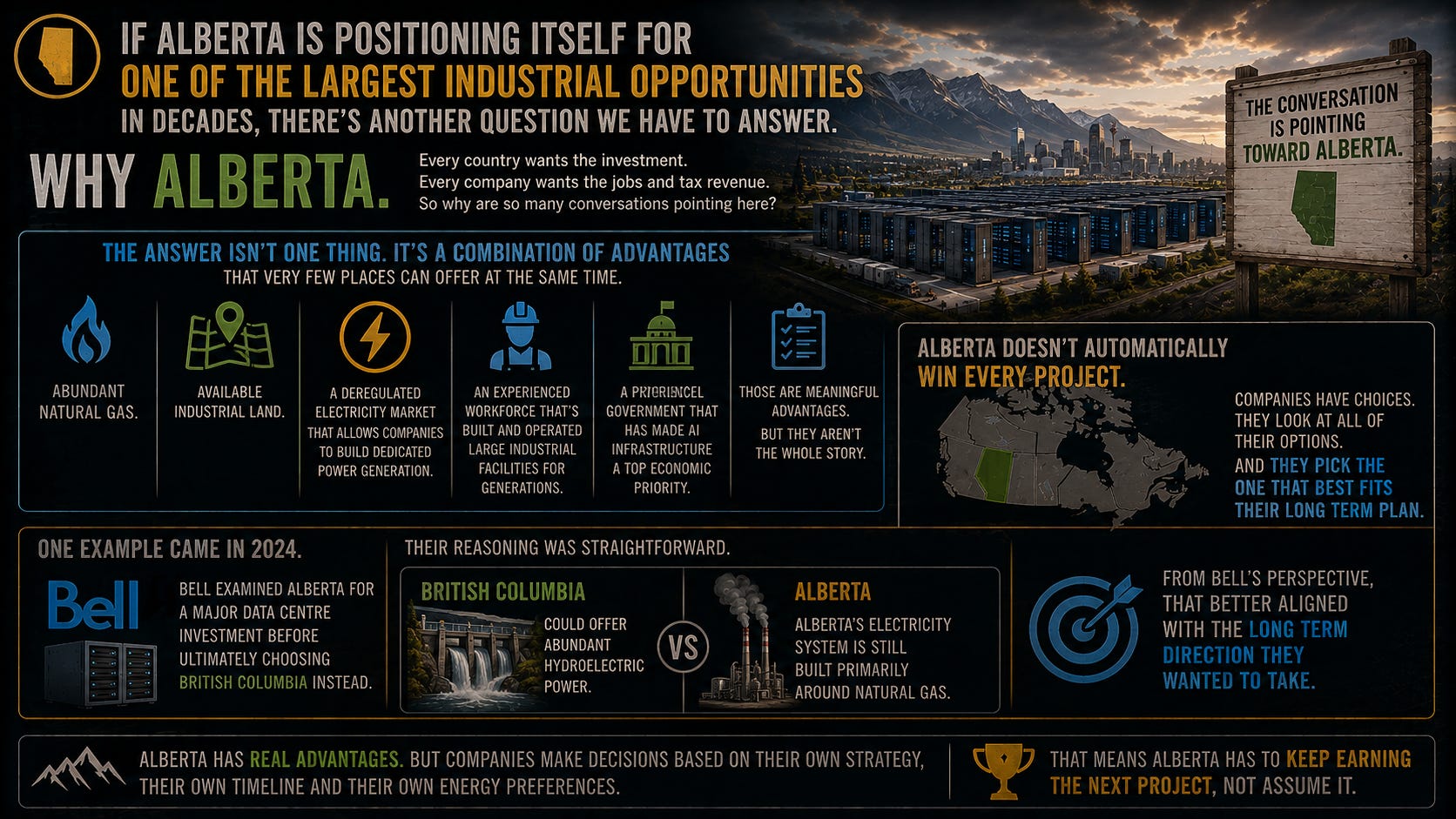
If Alberta is positioning itself for one of the largest industrial opportunities in decades, there’s another question we have to answer. Why Alberta.
After all, artificial intelligence isn’t unique to this province. Every country in the world is trying to figure out where it fits. Every major technology company is expanding its computing capacity. Every jurisdiction wants the investment, the jobs and the tax revenue that come with it. So why are so many of those conversations suddenly pointing toward Alberta?
The answer isn’t one thing. It’s a combination of advantages that very few places are able to offer at the same time. Abundant natural gas. Available industrial land. A deregulated electricity market that allows companies to build dedicated power generation. An experienced workforce that’s spent generations constructing and operating large industrial facilities. And a provincial government that has made attracting artificial intelligence infrastructure one of its economic priorities.
Those are meaningful advantages. But they aren’t the whole story, because Alberta doesn’t automatically win every project.
One example came in 2024, when Bell examined Alberta for a major data centre investment before ultimately choosing British Columbia instead. Their reasoning was straightforward. British Columbia could offer abundant hydroelectric power, while Alberta’s electricity system is still built primarily around natural gas. From Bell’s perspective, that better aligned with the long term direction they wanted to take.
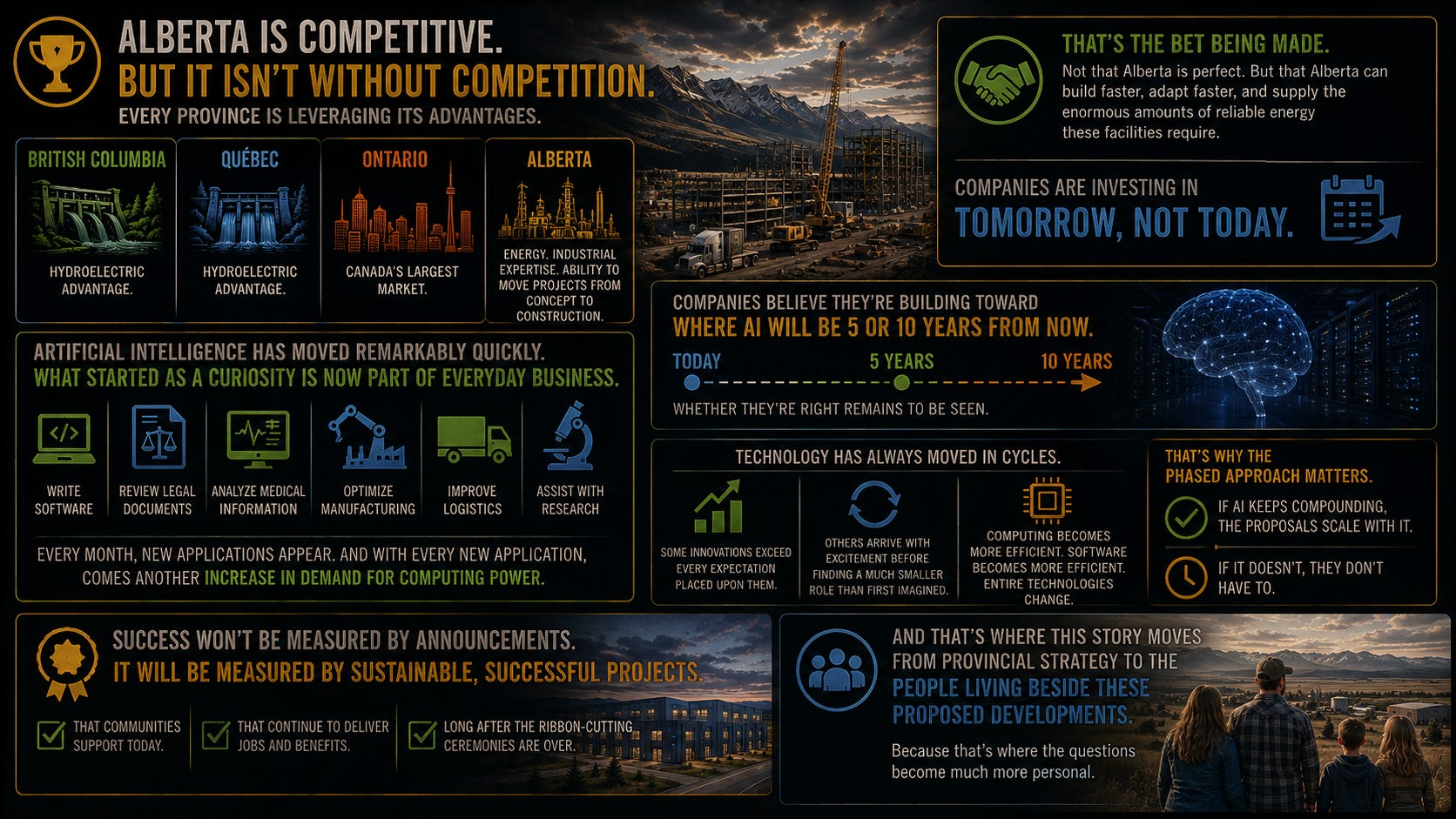
That tells us something important. Alberta is competitive. But it isn’t without competition. Every province is trying to leverage the advantages it already has. British Columbia points to hydroelectricity. Quebec does the same. Ontario has the country’s largest market. Alberta’s competitive advantage has always been energy, industrial expertise and the ability to move major projects from concept to construction.
That’s the bet being made. Not that Alberta is perfect. But that Alberta can build faster, adapt faster and supply the enormous amounts of reliable energy these facilities require. And when you step back, that’s really what companies are investing in. Not today’s demand. Tomorrow’s.
Artificial intelligence has moved remarkably quickly over the last few years. What started as a curiosity has become part of everyday business. Companies are using it to write software, review legal documents, analyze medical information, optimize manufacturing, improve logistics and assist with research. Every month new applications appear, and with every new application comes another increase in demand for computing power.
That’s what companies believe they’re building toward. Not where artificial intelligence sits today, but where they believe it will be 5 or 10 years from now. Whether they’re right remains to be seen.
Technology has always moved in cycles. Some innovations exceed every expectation placed upon them. Others arrive surrounded by excitement before eventually finding a much smaller role than people first imagined. Artificial intelligence may eventually become as transformative as electricity or the internet. It may also evolve in ways nobody currently expects. Computers become more efficient. Software becomes more efficient. Entire technologies change.
That’s also why the phased approach we described earlier matters here specifically. If artificial intelligence keeps compounding the way it has, these proposals scale with it. If it doesn’t, they don’t have to.
Which brings us back to Alberta. Because success here won’t be measured by how many announcements are made. It will be measured by how many of those announcements ultimately become successful, sustainable projects that communities continue supporting long after the ribbon cutting ceremonies are over.
And that’s where this story moves from provincial strategy to the people living beside these proposed developments, because that’s where the questions become much more personal.
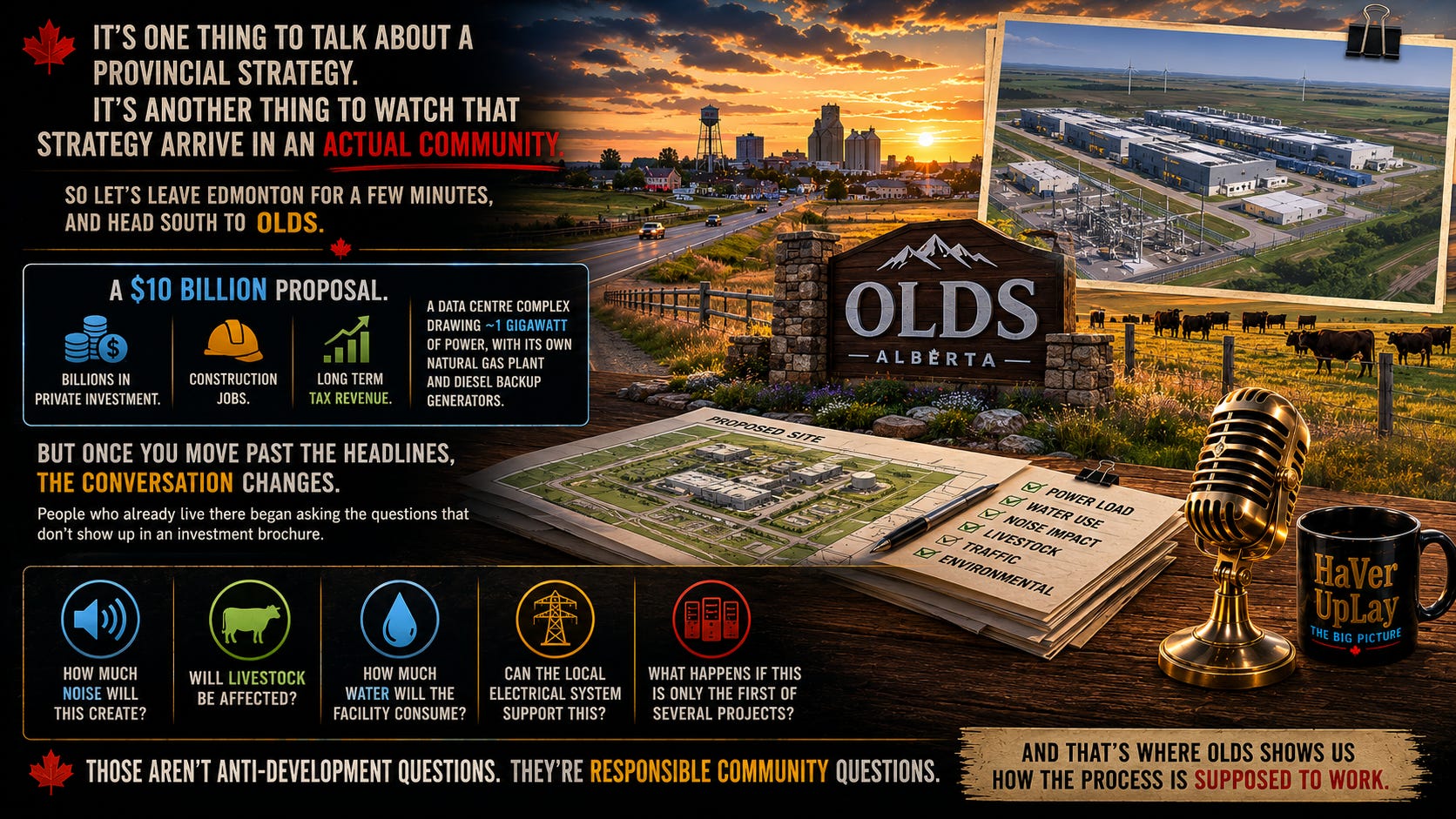
It’s one thing to talk about a provincial strategy. It’s something entirely different to watch that strategy arrive in an actual community. So let’s leave Edmonton for a few minutes, and head south to Olds. Because if Alberta is going to become the centre of Canada’s data centre industry, communities like Olds are where that vision either succeeds, or fails.
On paper, the proposal is impressive. A company called Synapse Data Center wants to build a $10 billion complex there, drawing about 1 gigawatt of power, backed by its own natural gas plant and its own fleet of diesel backup generators. Billions of dollars in private investment. Construction jobs. Long term tax revenue. The kind of announcement that would get almost any municipality’s attention.
But once you move past the headlines, the conversation changes, because people who already live there began asking questions that don’t show up in an investment brochure. How much noise will this create. Will livestock be affected. How much water will the facility actually consume. Can the local electrical system support it. What happens if this is only the first of several projects.
Those aren’t anti-development questions. They’re the kinds of questions every responsible community should be asking before approving a major industrial project. And here’s where Olds actually becomes useful to this story, not because everything has gone smoothly, but because it shows what happens when the review process does its job.
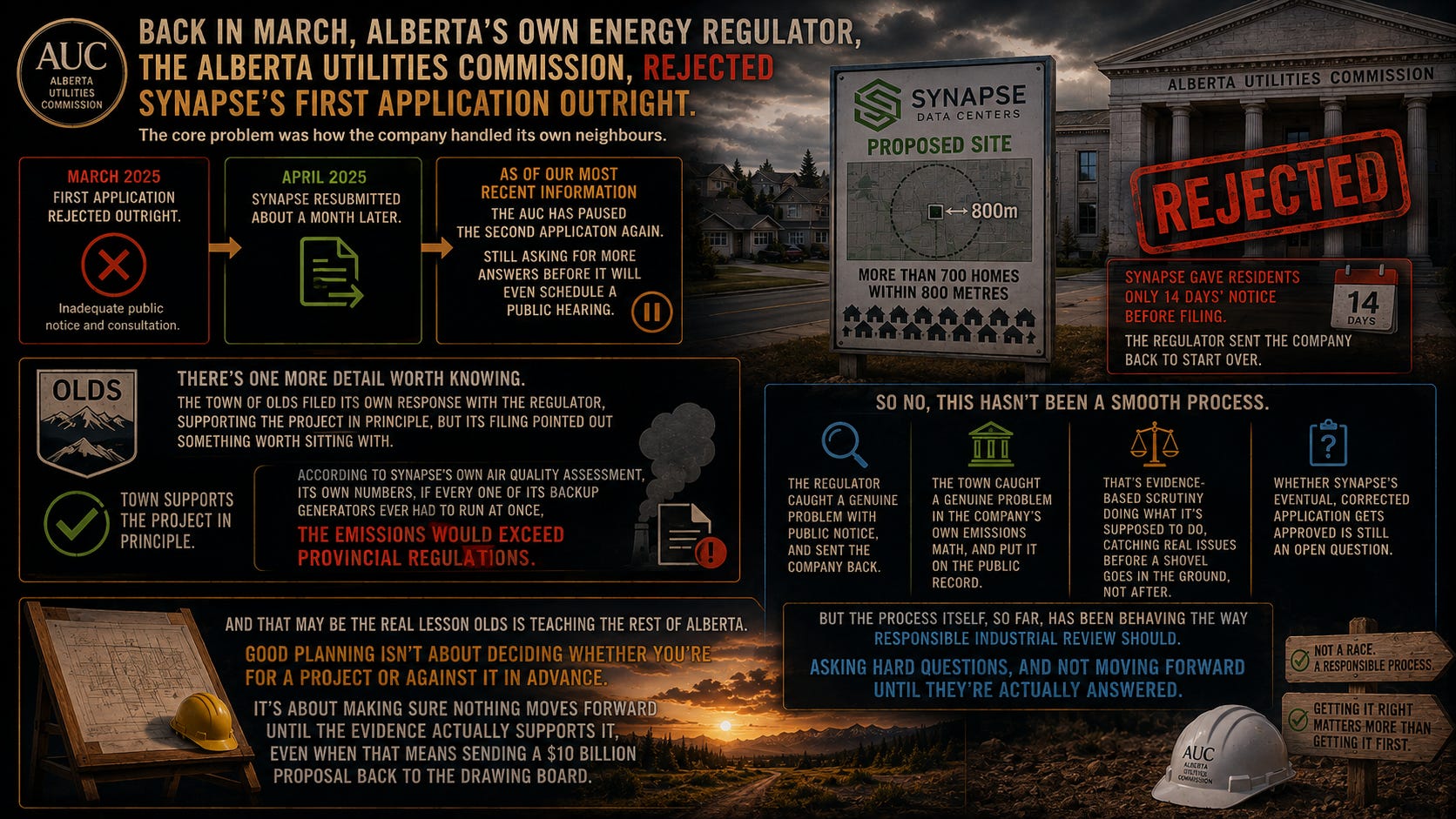
Back in March, Alberta’s own energy regulator, the Alberta Utilities Commission, rejected Synapse’s first application outright. The core problem was how the company handled its own neighbours. More than 700 homes sit within 800 metres of the site, and Synapse gave those residents only 14 days’ notice before filing. The regulator sent the company back to start over. Synapse resubmitted about a month later, and as of our most recent information, the Commission has paused that second application again, still asking for more answers before it will even schedule a public hearing.
There’s one more detail worth knowing. The Town of Olds filed its own response with the regulator, supporting the project in principle, but its filing pointed out something worth sitting with. According to Synapse’s own air quality assessment, its own numbers, if every one of its backup generators ever had to run at once, the emissions would exceed provincial regulations.
So no, this hasn’t been a smooth process, and we’re not going to pretend it has been. It’s been a contested one, with a real rejection, a real resubmission, and a real, still-open question hanging over the company’s own numbers. But that’s actually the useful part. The regulator caught a genuine problem with public notice, and sent the company back. The Town caught a genuine problem in the company’s own emissions math, and put it on the public record. That’s evidence-based scrutiny doing what it’s supposed to do, catching real issues before a shovel goes in the ground, not after.
Whether Synapse’s eventual, corrected application gets approved is still an open question. But the process itself, so far, has been behaving the way responsible industrial review should. Asking hard questions, and not moving forward until they’re actually answered.
And that may be the real lesson Olds is teaching the rest of Alberta. Good planning isn’t about deciding whether you’re for a project or against it in advance. It’s about making sure nothing moves forward until the evidence actually supports it, even when that means sending a $10 billion proposal back to the drawing board.
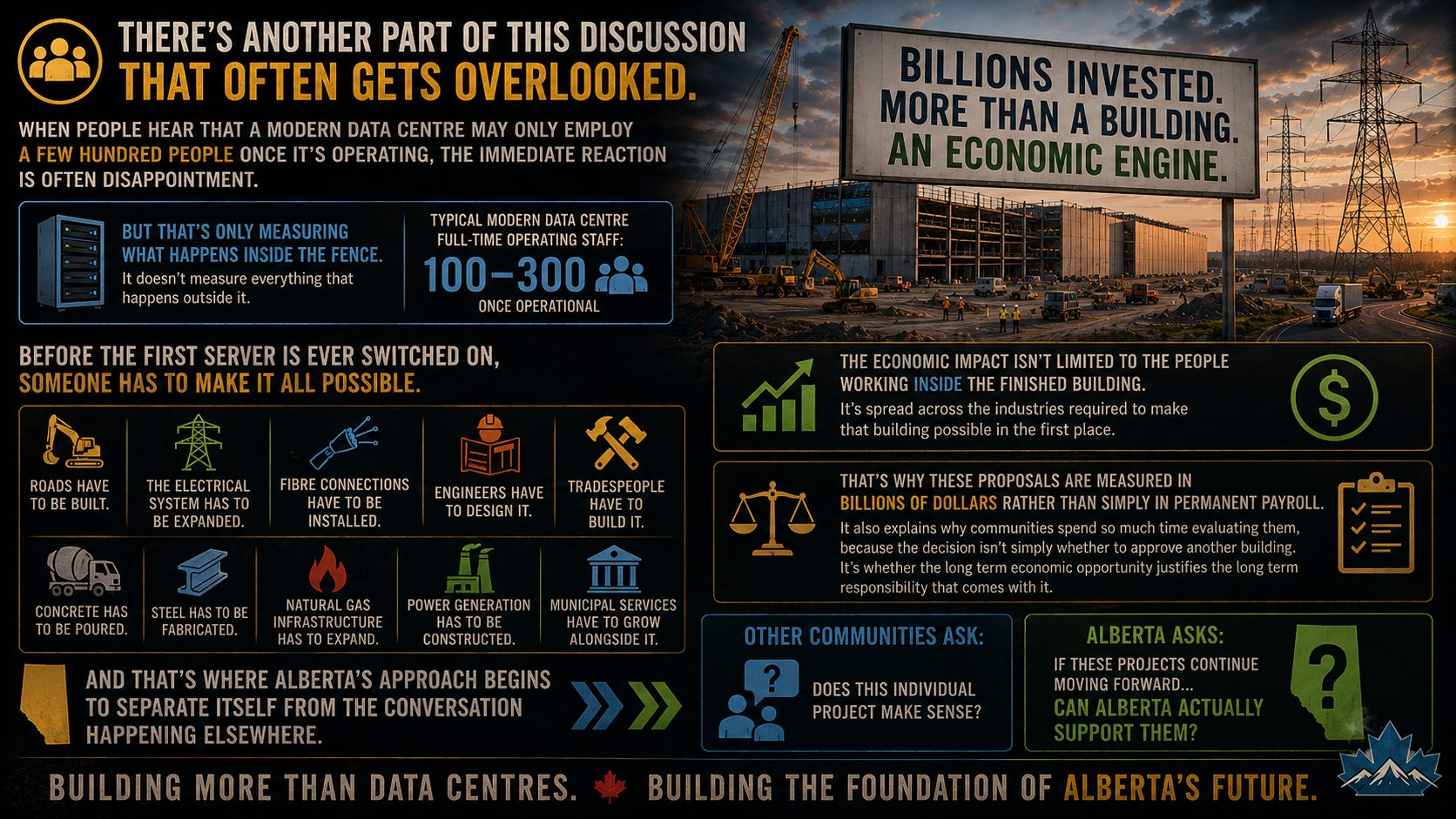
There’s another part of this discussion that often gets overlooked. When people hear that a modern data centre may only employ a few hundred people once it’s operating, the immediate reaction is often disappointment. Compared to a refinery or a manufacturing plant, those permanent employment numbers can seem surprisingly small.
But that’s only measuring what happens inside the fence. It doesn’t measure everything that happens outside it.
Before the first server is ever switched on, someone has to build the roads. Someone has to expand the electrical system. Someone has to install the fibre connections. Engineers have to design it. Tradespeople have to build it. Concrete has to be poured. Steel has to be fabricated. Natural gas infrastructure has to expand. Power generation has to be constructed. Municipal services have to grow alongside it.
The economic impact isn’t limited to the people working inside the finished building. It’s spread across the industries required to make that building possible in the first place. That’s why these proposals are measured in billions of dollars rather than simply in permanent payroll.
It also explains why communities spend so much time evaluating them, because the decision isn’t simply whether to approve another building. It’s whether the long term economic opportunity justifies the long term responsibility that comes with it.
And that’s where Alberta’s approach begins to separate itself from the conversation happening elsewhere. Because while communities like Olds are asking whether individual projects make sense, the province is asking a much larger question. If these projects continue moving forward, can Alberta actually support them?
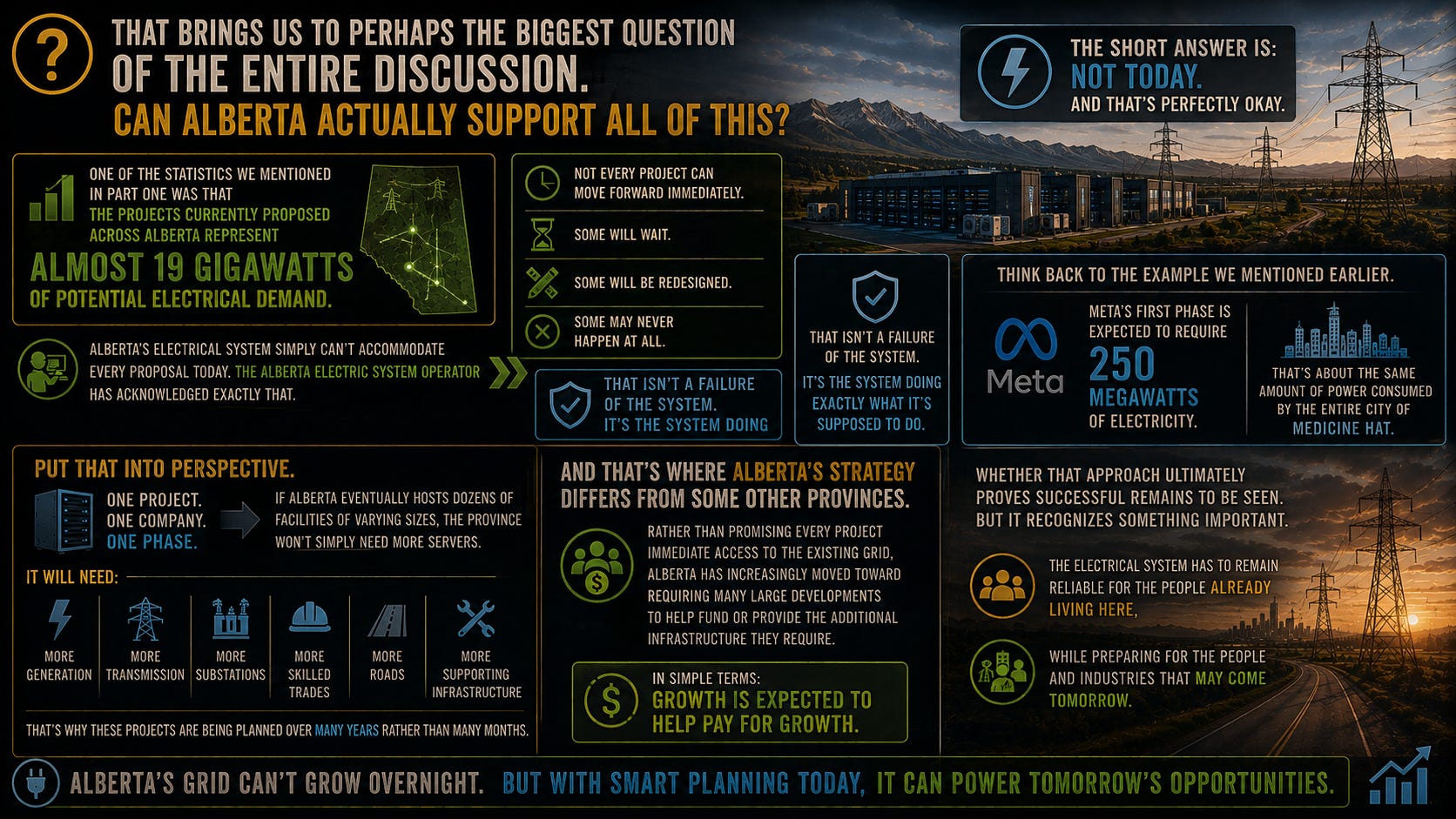
That brings us to perhaps the biggest question of the entire discussion. Can Alberta actually support all of this? The short answer is, not today. And that’s perfectly okay.
One of the statistics we mentioned in Part One was that the projects currently proposed across Alberta represent almost 19 gigawatts of potential electrical demand. That’s several times larger than what many people imagine when they hear the words data centre. Alberta’s electrical system simply can’t accommodate every proposal today. The Alberta Electric System Operator has acknowledged exactly that. Not every project can move forward immediately. Some will wait. Some will be redesigned. Some may never happen at all. That isn’t a failure of the system. It’s the system doing exactly what it’s supposed to do.
Think back to the example we mentioned earlier. Meta’s first phase is expected to require roughly 250 megawatts of electricity. That’s about the same amount of power consumed by the entire City of Medicine Hat. One project. One company. One phase.
Put that into perspective. If Alberta eventually hosts dozens of facilities of varying sizes, the province won’t simply need more servers. It will need more generation, more transmission, more substations, more skilled trades, more roads, more supporting infrastructure. That’s why these projects are being planned over many years rather than many months. Growth has to occur together. Not independently.
And that’s where Alberta’s strategy differs from some other provinces. Rather than promising every project immediate access to the existing grid, Alberta has increasingly moved toward requiring many large developments to help fund or provide the additional infrastructure they require. In simple terms, growth is expected to help pay for growth. Whether that approach ultimately proves successful remains to be seen. But it recognizes something important. The electrical system has to remain reliable for the people already living here, while preparing for the people and industries that may come tomorrow.
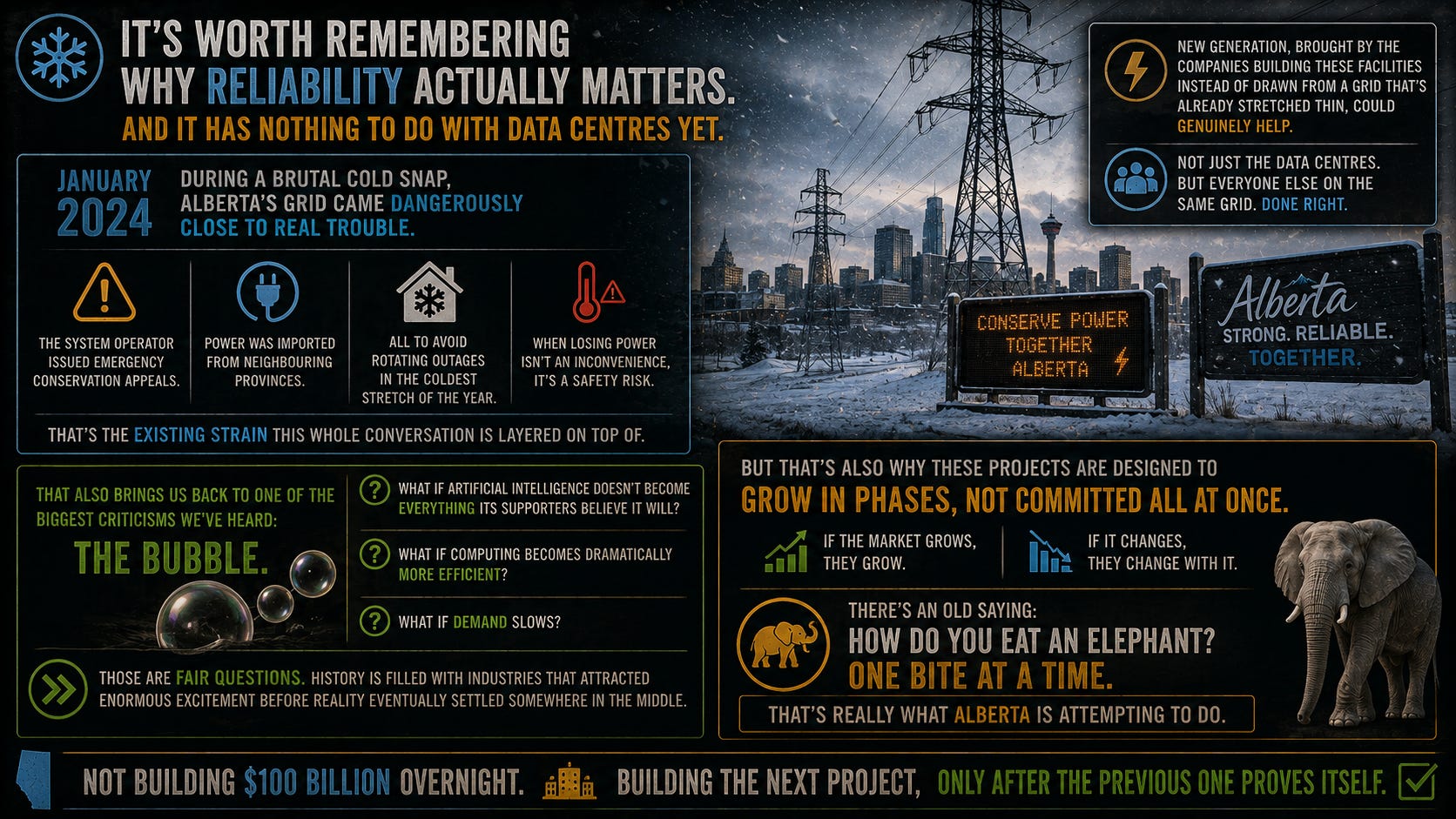
It’s worth remembering why that reliability question actually matters, and it has nothing to do with data centres yet. In January 2024, during a brutal cold snap, Alberta’s grid came close enough to real trouble that the system operator issued emergency conservation appeals and imported power from neighbouring provinces just to avoid rotating outages, in the coldest stretch of the year, when losing power isn’t an inconvenience, it’s a safety risk. That’s the existing strain this whole conversation is layered on top of. It’s also the case for why new generation, brought by the companies building these facilities instead of drawn from a grid that’s already stretched thin, could genuinely help, not just the data centres, but everyone else on the same grid. Done right.
That also brings us back to one of the biggest criticisms we’ve heard throughout this series. The bubble. What if artificial intelligence doesn’t become everything its supporters believe it will. What if computing becomes dramatically more efficient. What if demand slows. Those are fair questions. History is filled with industries that attracted enormous excitement before reality eventually settled somewhere in the middle. But that’s also why these projects are designed to grow in phases, not committed all at once. If the market grows, they grow. If it changes, they change with it.
There’s an old saying. How do you eat an elephant? One bite at a time. That’s really what Alberta is attempting to do. Not build $100 billion worth of infrastructure overnight. Build the next project, only after the previous one proves itself.
Now.
Here’s the Big Picture.
When we began this series, a lot of people wanted a simple answer. Are data centres good, or are they bad. We don’t think that’s actually the right question, and after two episodes, we’re not going to hand you our own verdict pretending we’ve settled it. Instead, here’s something more useful. Here’s what the people and institutions actually inside this story have concluded, in their own words and their own decisions, so far.
Alberta’s government has made its verdict clear through action. It’s betting on this industry, aiming to attract $100 billion in investment over 5 years, and building a policy, growth pays for growth, meant to let that happen without putting the existing grid at risk.
Alberta’s own grid operator has been more cautious. Its position, in effect, is that large new industrial loads put real pressure on the system until enough new generation actually gets built, and that not every proposed project can be connected today.
Bell reached its own verdict back in 2024. It looked at Alberta, and chose British Columbia instead, because hydroelectric power fit the direction the company wanted to go.
Alberta’s own energy regulator reached a verdict on Olds specifically. Not on data centres generally. On this one application. And that verdict was no, not yet, come back when you’ve actually talked to your neighbours.
And the Town of Olds reached its own verdict too. Support, in principle, but with its name attached to a filing that put the company’s own numbers on the public record.
None of those verdicts agree with each other, and that’s the point. This isn’t a story with one ending yet. It’s a story with several institutions, at several levels, each doing their own job, and each landing in a slightly different place.
What we can tell you is what we think the pattern shows. Scaling in, one project at a time, one proof point earning the next, is how major industries are supposed to grow. Alberta appears to be building the pieces for that, a phased approach to power, a regulator willing to say no to a specific application, a town willing to put a company’s own numbers on the public record. Whether all of those pieces hold together as the number of proposals grows from one to dozens, that’s the actual open question. Not whether Alberta should do this. Whether it can keep doing it carefully at 10 times the scale.
That’s really what this series has been about. Not data centres. Not Meta. Not artificial intelligence. Whether Alberta can keep making good decisions about its next major industry as that industry gets bigger, faster, than almost anything the province has built before.
Now we’d like your help. Should we continue digging and produce a Part Three? Or is it time to step back, connect everything we’ve uncovered, and turn this into one complete Big Picture documentary? Let us know in the comments, because this investigation started with your questions, and we’d like your help deciding where it goes next.
And now, you see the Big Picture.
I would keep digging. The Meta data center schedule of construction has them building the data centre first and then adding their power plant after three years. So it would draw from the Provincial Grid for three years before or if they even build their power plant. AESO is correct in protecting the grid especially after last January's close call. Shaun Newman #1053 Minute 37:01 did a podcast with a brilliant young man Hakeem Anwar out of the states who has been watching these data centers grow and the folow on issues. Danielle Smith coined the term regarding data Centers is "Bring your Own Power" which I suspect will vanish if she needs the proposed investment to stay in power. If I can help in anyway let me know Ian@ianparkinson.ca
Not sure why I am not able to open this video?