
Data Centres...
And the beginning of our Deep Dive.

Happy Friday, YakkStackers. A few days ago, we handed you the microphone and asked what stories you wanted us to investigate. The response was overwhelming, but one topic rose above the rest. So today's episode belongs to you. We followed your suggestion, dug into the research, and built this week's Big Picture around the questions you wanted answered. Keep the ideas coming...because every Friday, this conversation starts with you.
Transcripts:
A few days ago, we handed you the microphone and told you Fridays were going to belong to you. Your ideas, your questions, the conversations you're actually having around your own kitchen tables, not just whatever happened to be making headlines that morning. And you delivered. The emails came in, the comments kept coming, the direct messages filled up with outstanding ideas. But one topic kept rising back to the top: data centres.

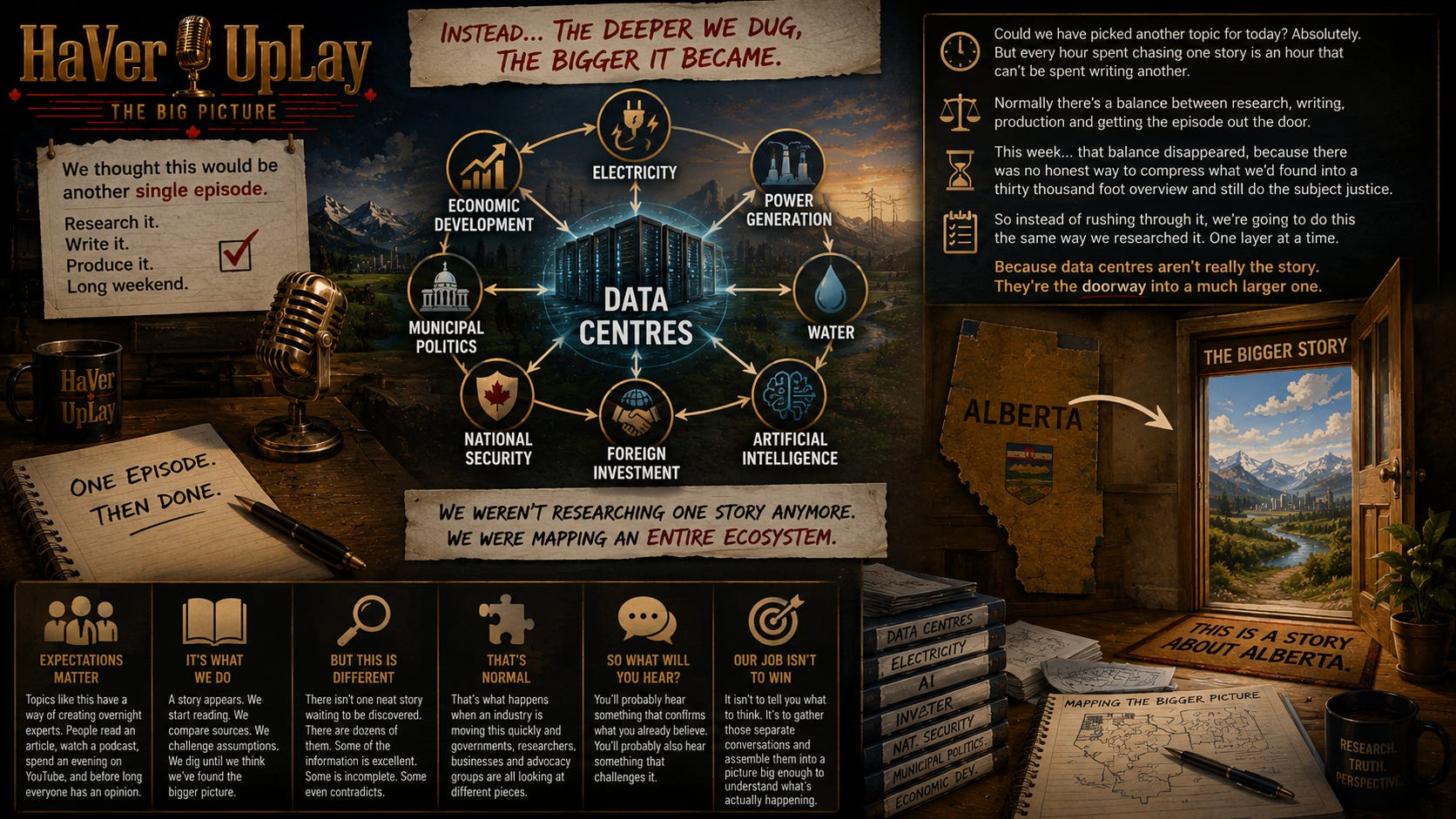
We thought this would be another single episode: research it, write it, produce it, long weekend. Instead, the deeper we dug, the bigger it became. Data centres led to electricity, power generation, water, artificial intelligence, foreign investment, national security, municipal politics and economic development. We weren't researching one story anymore. We were mapping an entire ecosystem. Because data centres aren't really the story. They're the doorway into a much larger one, and that larger one is about Alberta.
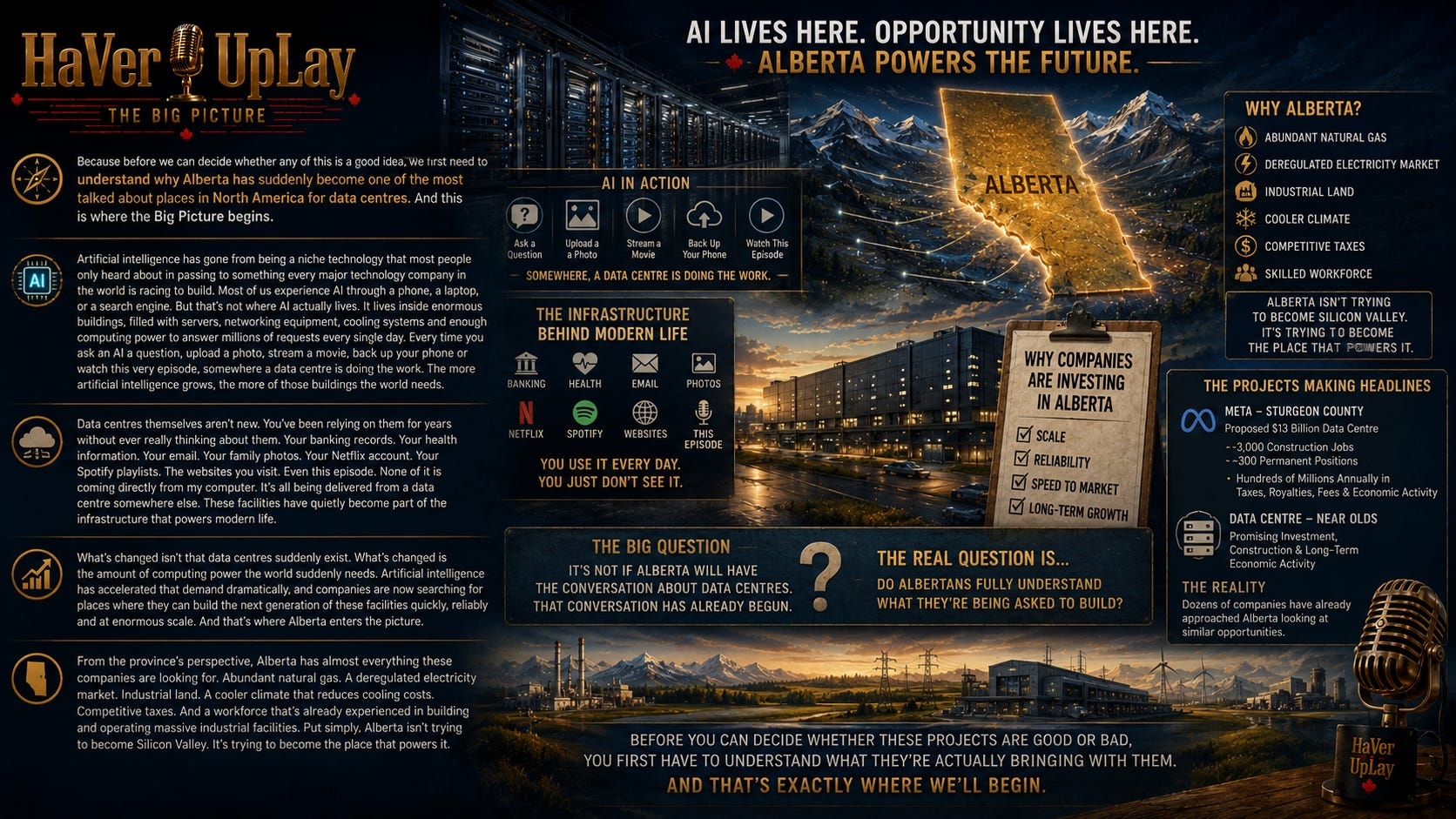
Artificial intelligence lives inside enormous buildings full of servers, and the more it grows, the more of those buildings the world needs. Data centres aren't new, you've relied on them for years without thinking about it, your banking, your health records, your email, even this episode. What's changed is how much computing power the world suddenly needs. Alberta has almost everything these companies are looking for: abundant natural gas, a deregulated electricity market, industrial land, a cooler climate, competitive taxes, and an experienced workforce. Alberta isn't trying to become Silicon Valley. It's trying to become the place that powers it. Meta's proposed $13 billion data centre in Sturgeon County is the project you've probably heard the most about, promising roughly 3,000 construction jobs, around 300 permanent positions, and hundreds of millions of dollars a year in economic activity. Another proposal near Olds is drawing attention too. But this isn't really about Meta or Olds alone, dozens of companies have already approached Alberta. The real question is whether Albertans understand what they're being asked to build.
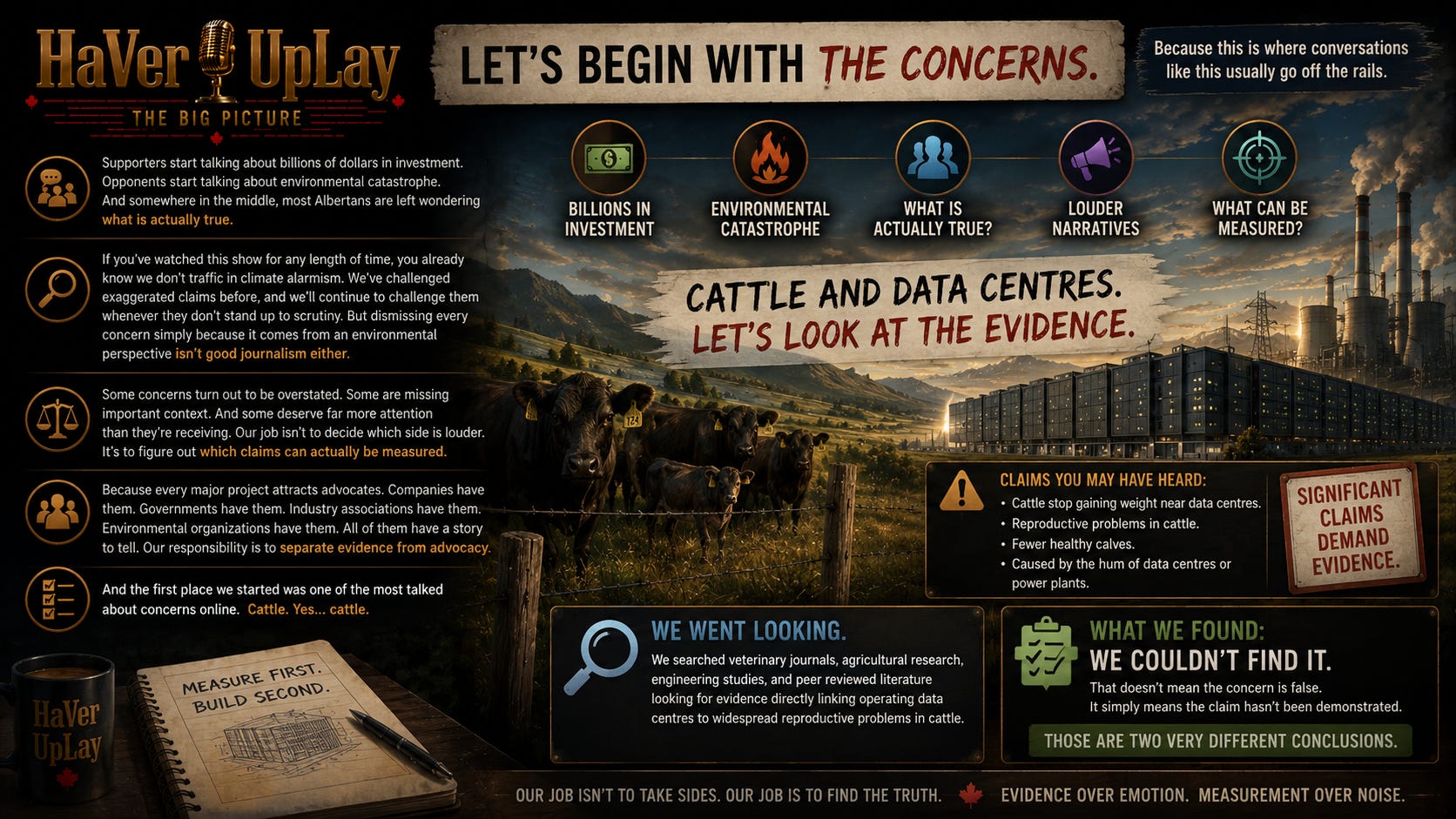
Let's begin with the concerns, because this is where conversations like this usually go off the rails. If you've watched this show, you know we don't traffic in climate alarmism, but dismissing every concern because it comes from an environmental perspective isn't good journalism either. Our job isn't to decide which side is louder, it's to figure out which claims can actually be measured. The first place we started was one of the most talked about concerns online: cattle. Claims are circulating that cattle near data centres stop gaining weight, have reproductive problems, or produce fewer healthy calves. We searched veterinary journals, agricultural research, and peer reviewed literature for evidence directly linking data centres to these effects in cattle. We couldn't find it. That doesn't mean the concern is false, it means the claim hasn't been demonstrated.
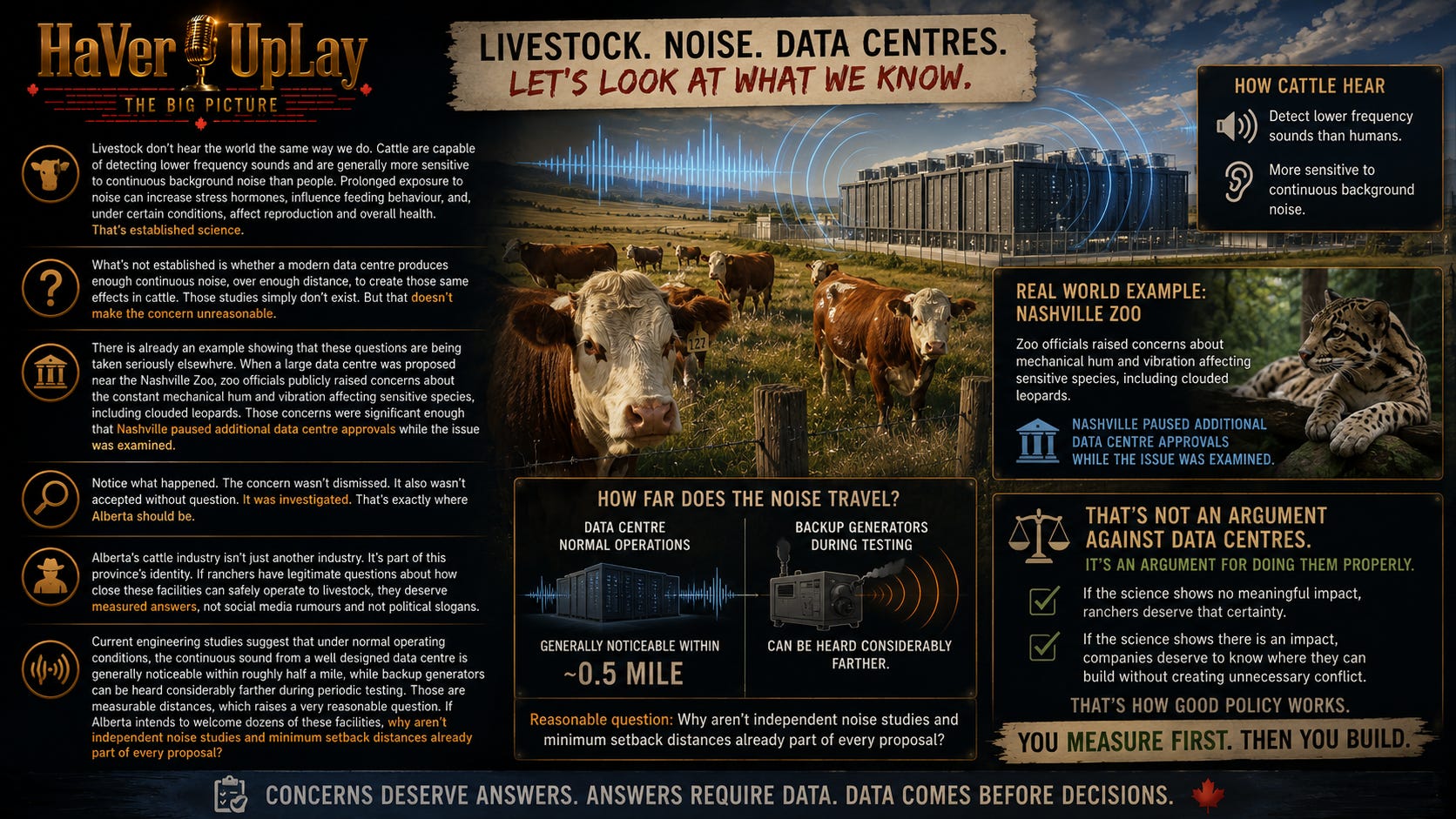
Here's what we do know: livestock don't hear the world the way we do. Cattle detect lower frequency sounds and are more sensitive to continuous background noise. Prolonged noise exposure is known to raise stress hormones and affect feeding and reproduction, that's established science. What's not established is whether a modern data centre produces enough continuous noise, over enough distance, to cause those effects. But that doesn't make the concern unreasonable. When a data centre was proposed near the Nashville Zoo, officials raised concerns about mechanical hum and vibration affecting sensitive species like clouded leopards, and Nashville paused additional approvals while it examined the issue. That's exactly where Alberta should be: not dismissing the concern, not accepting it without question, investigating it. Engineering studies suggest normal operating noise is noticeable within roughly half a mile, with backup generators heard farther during testing. That raises a reasonable question: why aren't independent noise studies and minimum setback distances already part of every proposal?
You measure first. Then you build.
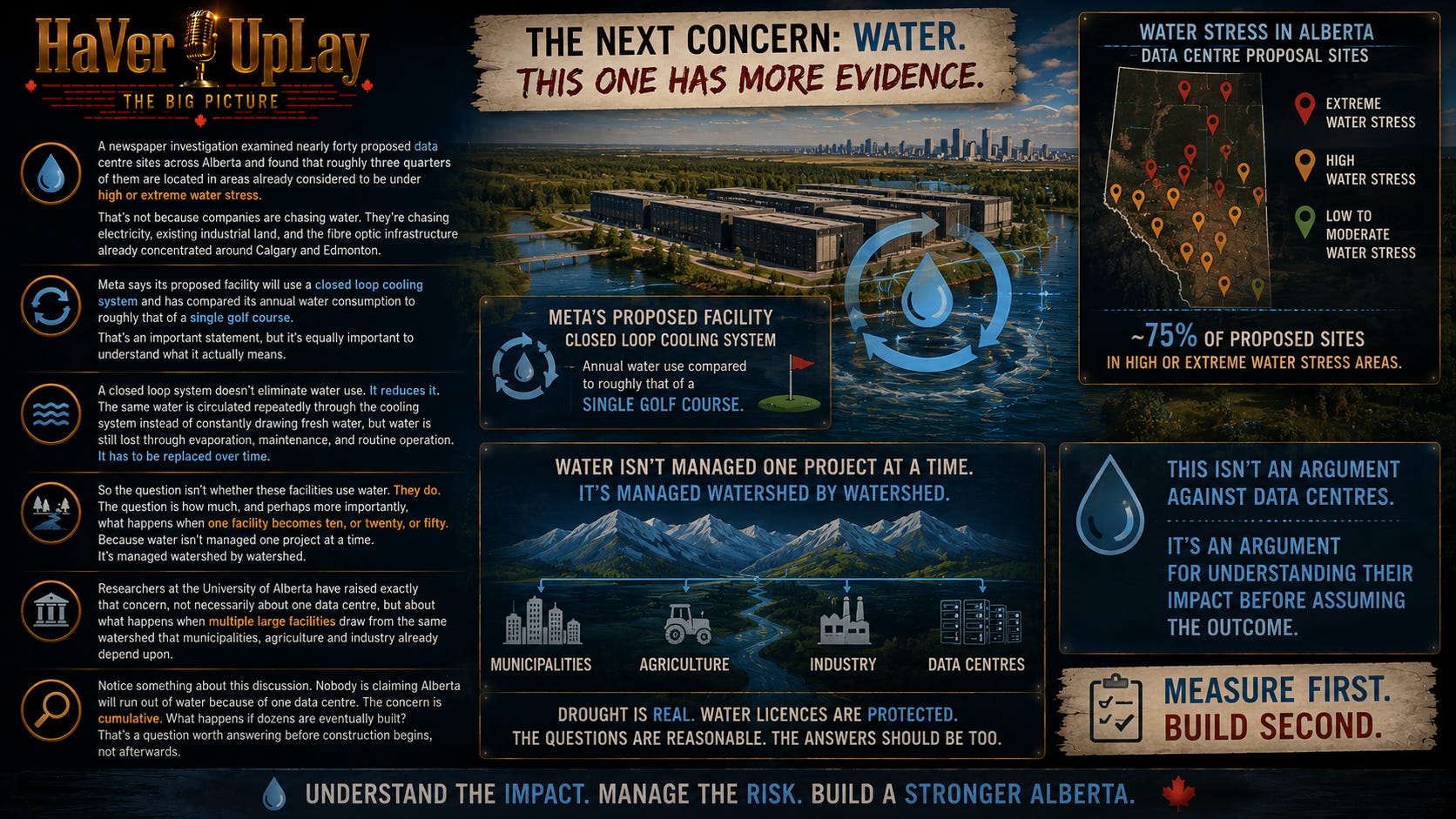
The next concern is water, and this one has considerably more evidence behind it. A newspaper investigation examined nearly 40 proposed data centre sites across Alberta and found roughly three quarters sit in areas already under high or extreme water stress, clustered because that's where the power lines and land already are. Meta says its closed loop cooling system will use only about as much water as a single golf course a year, but a closed loop system doesn't eliminate water use, it reduces it, water is still lost through evaporation and maintenance and has to be replaced over time. The real question isn't whether these facilities use water, it's how much, and what happens when one becomes ten or twenty or fifty, since water is managed watershed by watershed, not project by project. Nobody is claiming Alberta will run out of water over one data centre. The concern is cumulative, and that's worth answering before construction begins, not afterward.
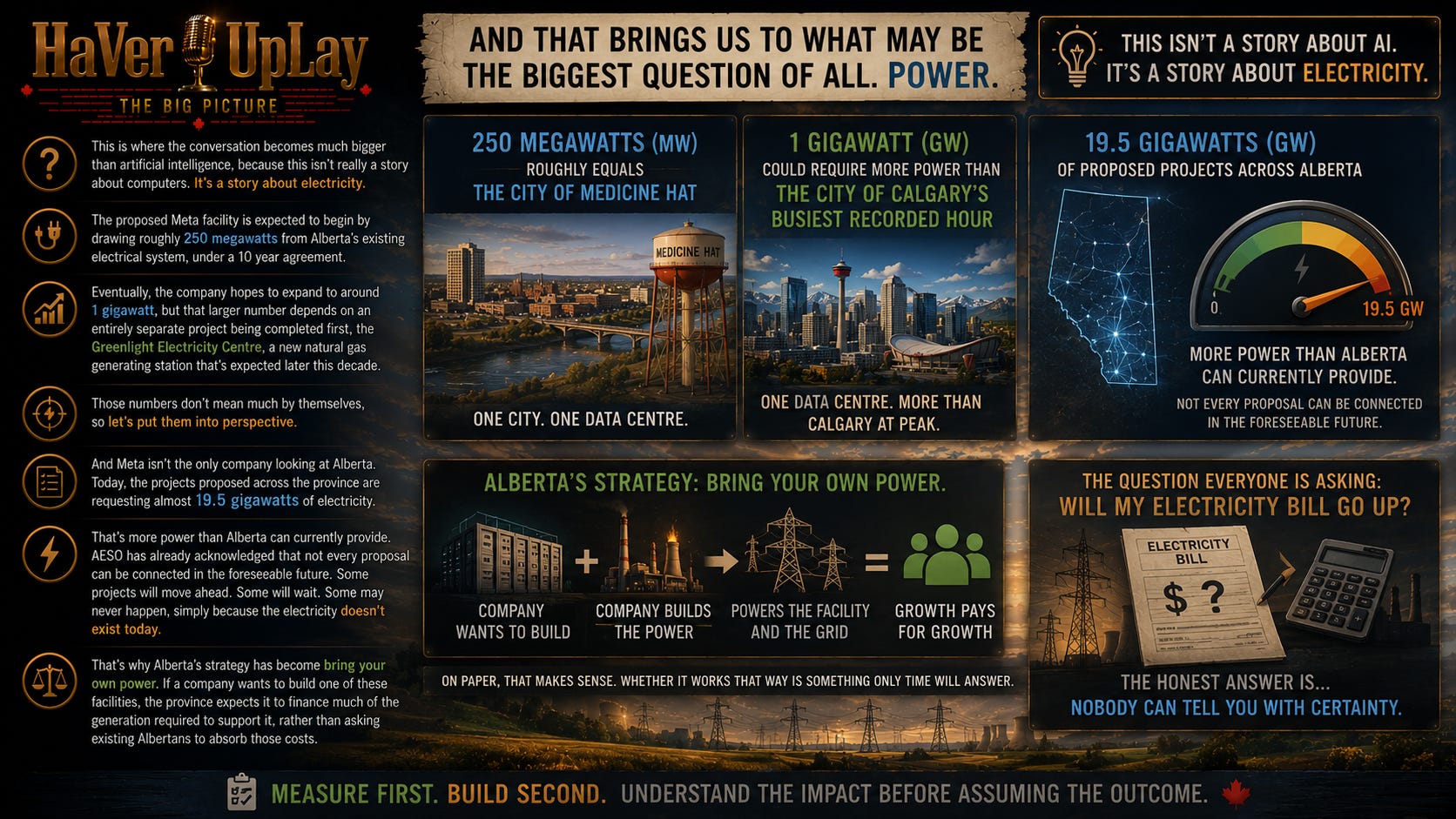
And that brings us to what may be the biggest question of all…power. This isn't really a story about computers, it's a story about electricity. Meta's facility is expected to begin drawing roughly 250 megawatts, about what the entire City of Medicine Hat uses. One city, one data centre. If Meta eventually reaches its full planned capacity of around 1 gigawatt, that could require more electricity than the City of Calgary has ever consumed during its busiest recorded hour. And Meta isn't alone: projects proposed across Alberta are requesting almost 19.5 gigawatts of electricity, more than Alberta can currently provide. The Alberta Electric System Operator has acknowledged not every proposal can be connected in the foreseeable future. That's why Alberta's strategy has become bring your own power: companies finance much of their own generation instead of asking existing Albertans to absorb the cost.
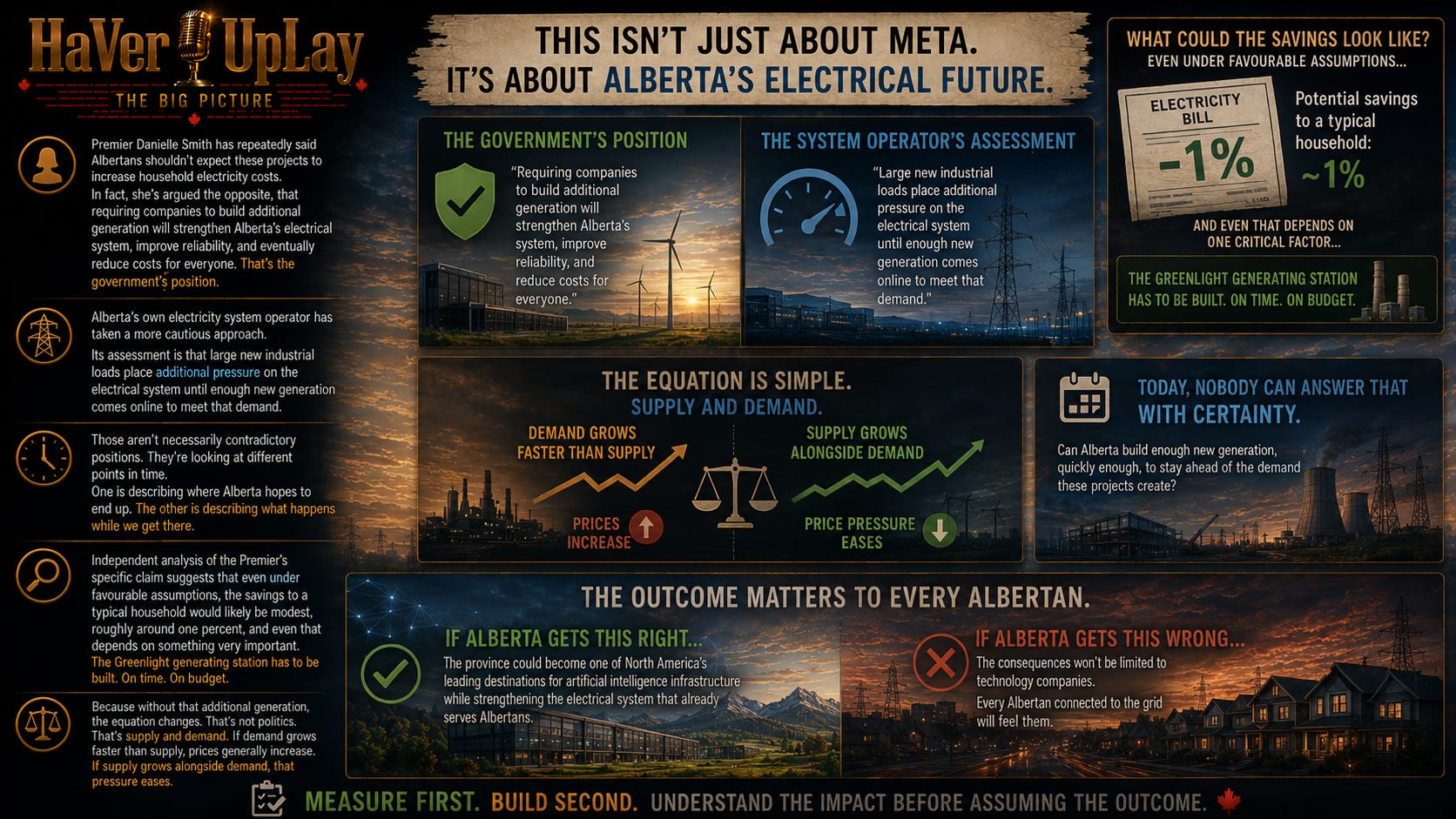
This isn't just about Meta, it's about Alberta's electrical future. Premier Danielle Smith says these projects will strengthen the system and eventually lower costs. Alberta's own electricity system operator has taken a more cautious view, saying large new industrial loads place additional pressure on the system until enough new generation comes online. Those aren't necessarily contradictory, they're describing different points in time. An independent check of the Premier's specific claim found the realistic savings to a typical household would be modest, roughly 1%, and that depends entirely on the Greenlight Electricity Centre actually being built, on time, on budget. If demand grows faster than supply, prices increase. If supply keeps pace, that pressure eases. Today, nobody can say with certainty which one happens. If Alberta gets this right, it could become a leading destination for this investment while strengthening its own grid. If it gets it wrong, every Albertan connected to that grid will feel it.
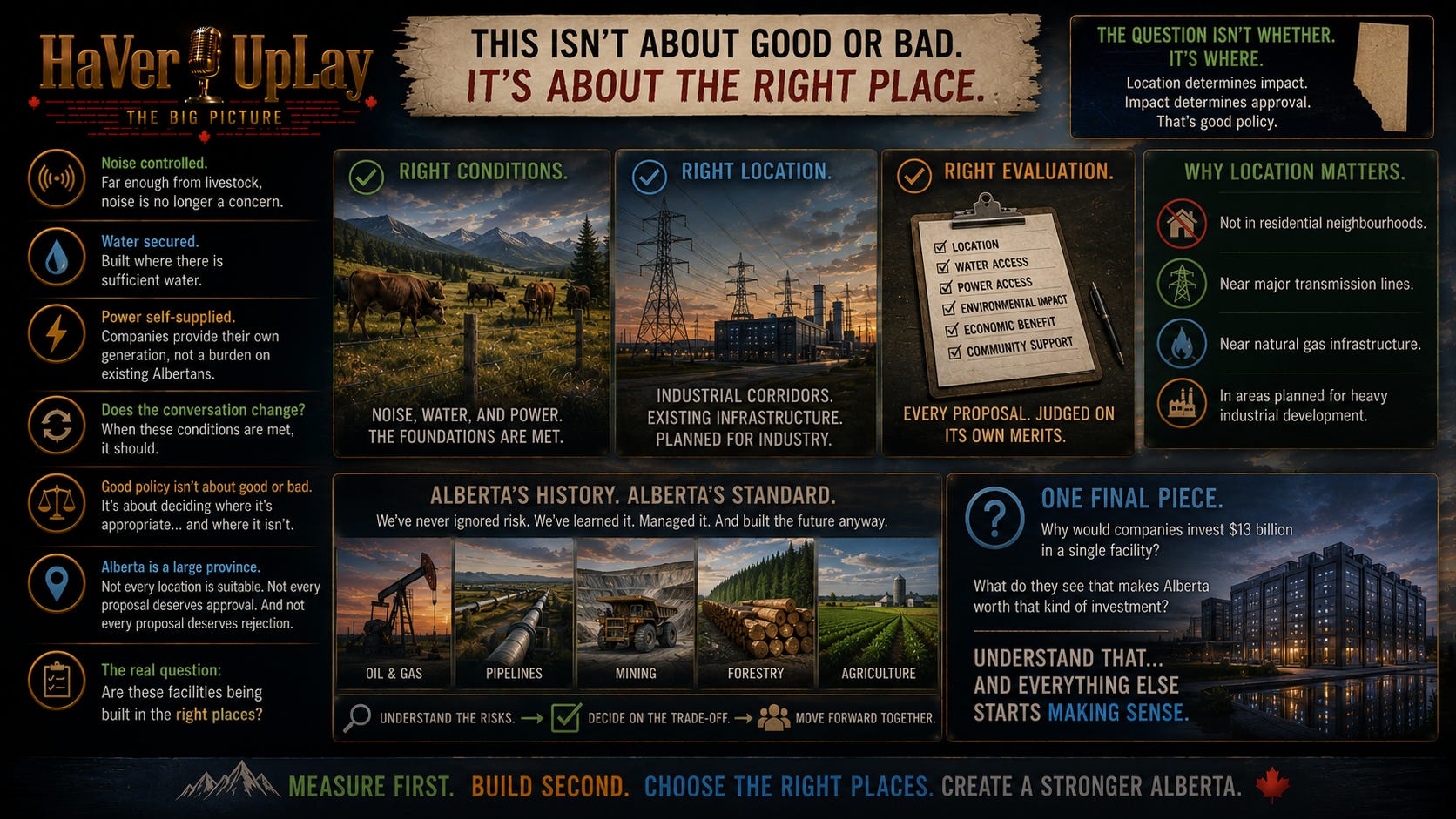
But here's where the conversation begins to change. If a data centre is far enough from livestock that noise isn't a concern, if it's built where there's sufficient water, if it supplies its own power instead of burdening existing Albertans, does that change things? It should. Good public policy isn't about deciding whether something is good or bad, it's about deciding where it's appropriate. Alberta is a large province, not every location is suitable, and not every proposal deserves approval or rejection. The projects getting the most attention are largely directed toward existing industrial corridors, near transmission lines and gas infrastructure, in areas long planned for heavy industry. Every proposal should be judged on its own merits: location, water access, power access, environmental impact, economic benefit, and whether the community beside it believes the trade-off is worth making. And before we can answer that, there's one more piece: why are companies willing to spend $13 billion on a single facility? Once you understand that, everything else starts making a lot more sense.
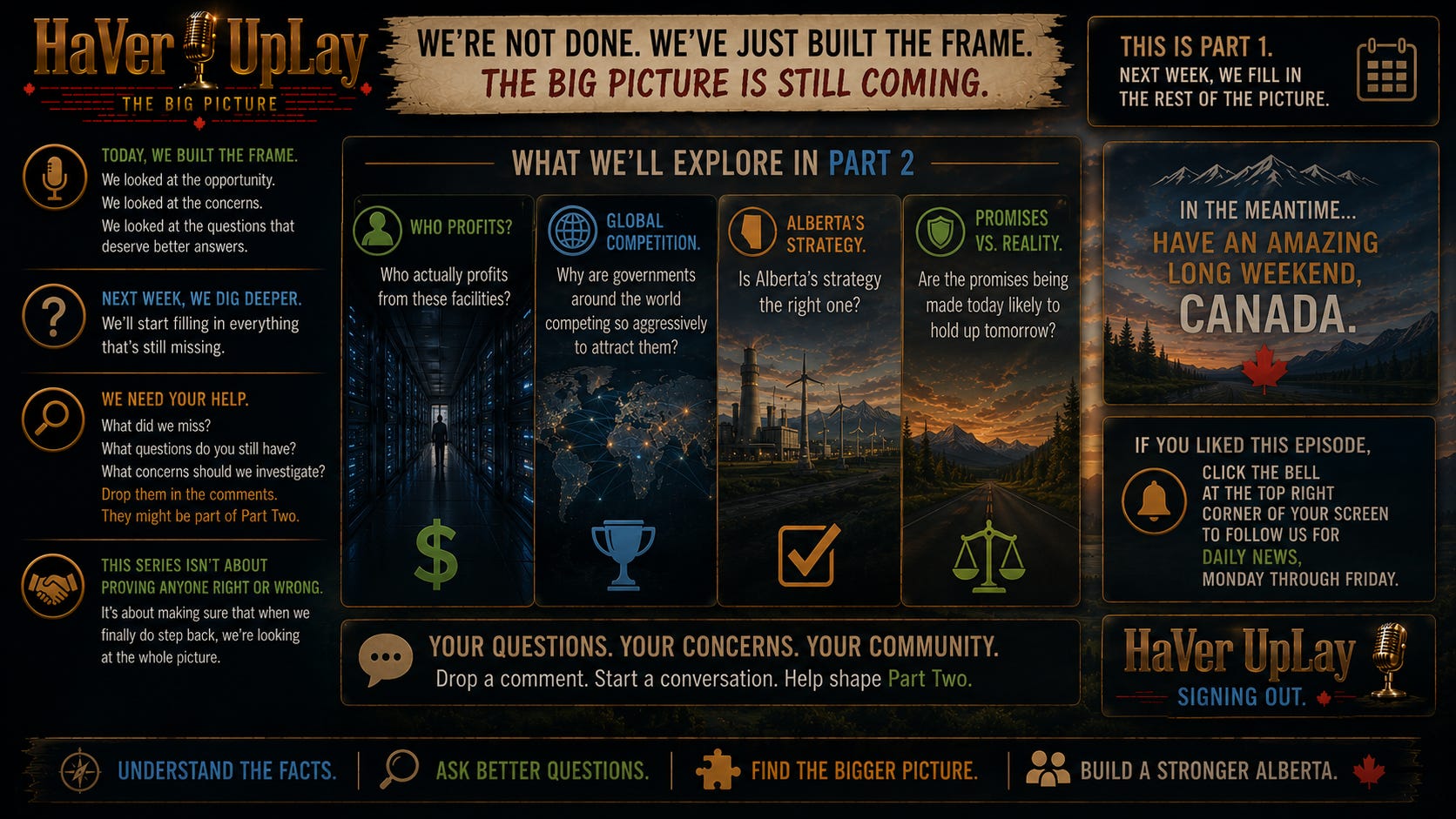
Normally we'd bring all of this together into the Big Picture, but we can't, not honestly, because today we've only built the frame. We've looked at the opportunity, the concerns, and the questions that deserve better answers. Next week, we start filling in what's still missing: who actually profits from these facilities, why governments around the world are competing this aggressively to attract them, whether Alberta's strategy is the right one, and whether the promises being made today will hold up tomorrow. In the meantime, we'd like your help. What questions do you still have? What concerns have you heard that we should investigate? Drop them in the comments, there's a good chance they'll become part of Part Two. This series isn't about proving anyone right or wrong, it's about making sure that when we finally do step back, we're looking at the whole picture. Have an amazing long weekend, Canada. If you liked this episode, click the bell at the top right corner of your screen to follow us for daily news, Monday through Friday. HaVer UpLay, signing out.
Well done and yes, it follows the lines of what I am thinking about. Looking forward to the rest of the analysis!
The Meta center is actually in the perfect spot in Sturgeon County. Yet the hysteria surrounding it, largely pushed by NDP bots on Facebook, is crazy. Now people from all over the province are planning protests against it, while Sturgeon County residents are welcoming this addition to our tax base.
When I started looking into them, there were numerous articles about how horrible they are, while I couldn’t find anything positive. That told me all I needed to know. A narrative is being pushed to block data centers in North America and who benefits? China probably.
When a narrative spreads fear, the opposite is usually true. Welcome Meta!