
Alberta Asked Twice...
Once through a referendum and then again through diplomacy.

Last week we talked about Alberta getting a bigger seat at the table.
Ottawa, once again, delivered a message as to why.
When there is no consequence to saying “No”, Alberta needs more leverage.
Transcripts:
If You’re Not At The Table, You’re On The Menu
Alberta voted in 2021. Alberta negotiated in 2026. Ottawa said no both times. Mark Carney has his own words for what that means — and Albertans vote on it October 19.
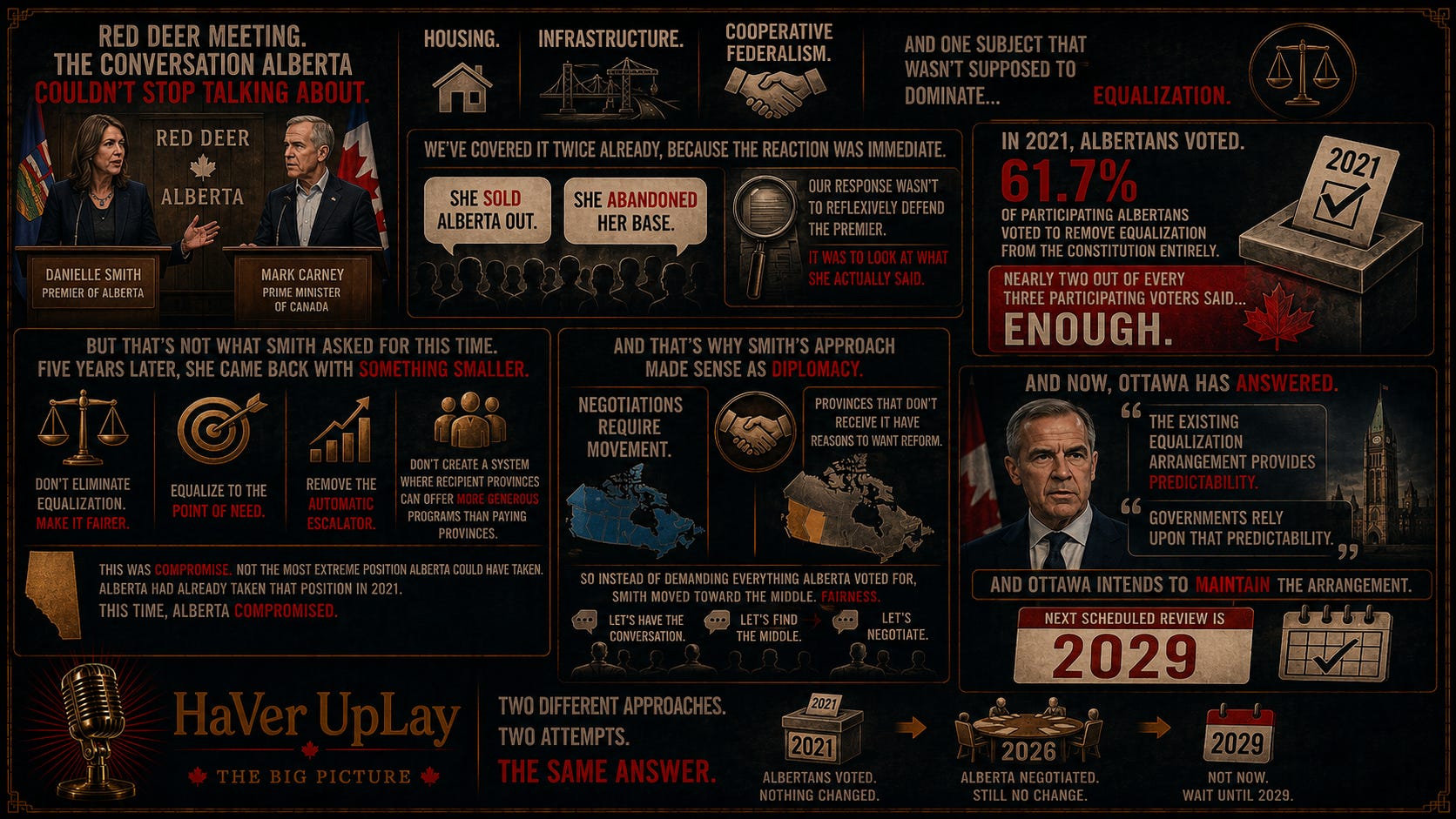
Over the last couple of weeks, this show has spent real time on that meeting in Red Deer between Premier Danielle Smith and Prime Minister Mark Carney. Housing. Infrastructure. Cooperative federalism. And one subject that wasn’t supposed to dominate the announcement: equalization.
We’ve covered it twice already, because the reaction to Smith’s comments was immediate. She sold Alberta out. She abandoned her base. Our response wasn’t to reflexively defend the Premier. It was to look at what she actually said.
Because what Smith put on the table in Red Deer wasn’t what 61.7% of participating Albertans voted for in 2021. That vote was considerably stronger. Albertans voted to remove equalization from the Constitution entirely. Nearly two out of every three participating voters said enough.
But that’s not what Smith asked for this time. Five years later, she came back to the table with something considerably smaller. Don’t eliminate equalization. Make it fairer. Equalize to the point of need. Remove the automatic escalator. And don’t create a system where provinces receiving equalization can offer more generous programs than the provinces whose taxpayers help fund the federal revenues behind it.
You can agree with that position. You can disagree with it. But you can’t reasonably call it the most extreme position Alberta could have taken, because Alberta had already taken that position, in 2021. This time, Alberta compromised.
And that’s why we said Smith’s approach in Red Deer made sense as diplomacy. Negotiations require movement. The provinces receiving equalization generally want to preserve the existing system. The provinces that don’t receive it have reasons to want reform. So instead of walking into the room demanding everything Alberta had voted for, Smith moved toward the middle. Fairness. And the appeal wasn’t only to Mark Carney. It was also an appeal to the other provinces. Let’s have the conversation. Let’s find the middle. Let’s negotiate.
And now, Ottawa has answered. Prime Minister Carney says the existing equalization arrangement provides predictability. Governments rely upon that predictability. And Ottawa intends to maintain the arrangement. The next scheduled review is 2029.
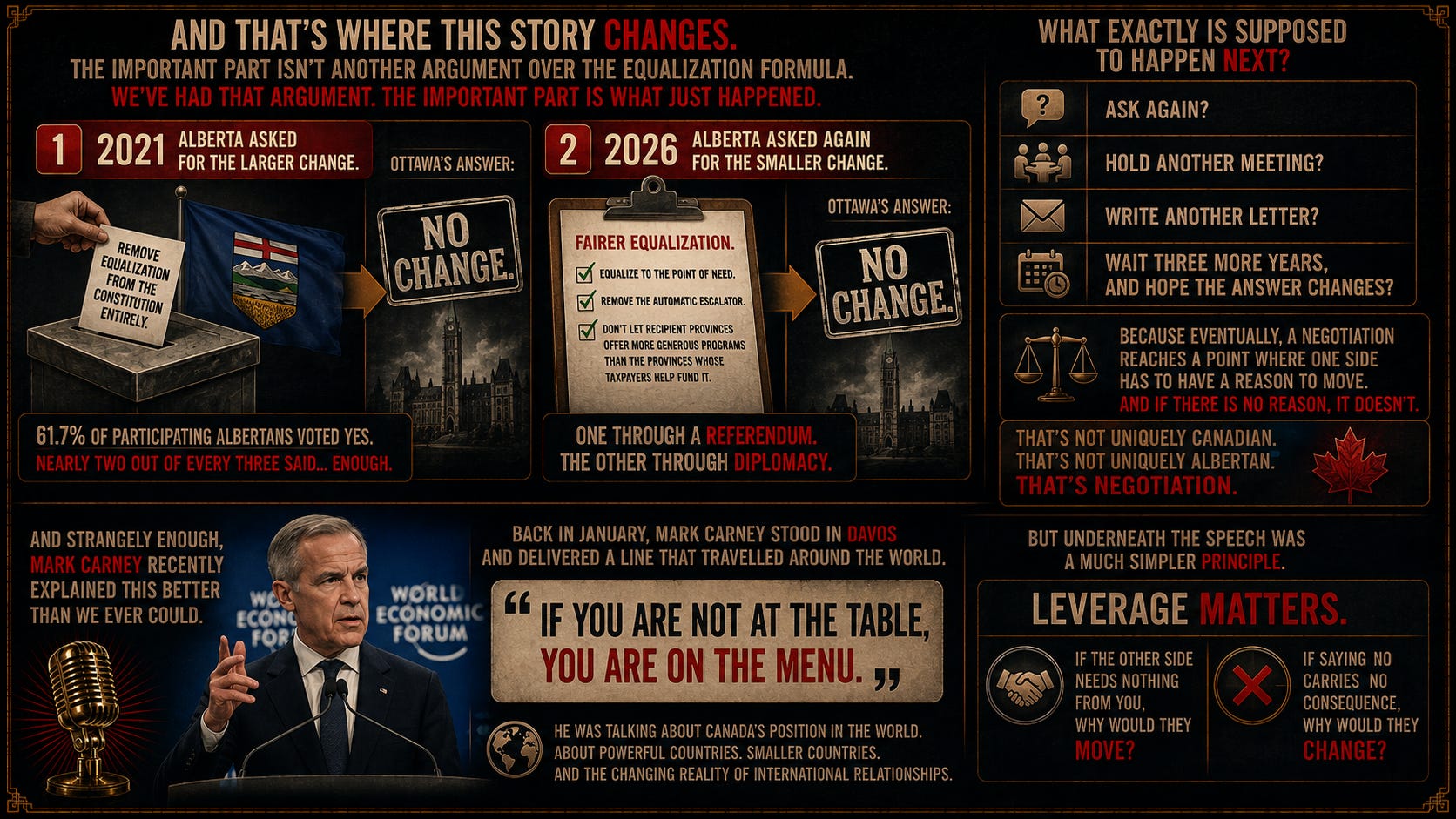
And that’s where this story changes. Because the important part isn’t another argument over the equalization formula. We’ve had that argument. The important part is what just happened.
Alberta asked for the larger change in 2021. No change. Alberta returned five years later asking for the smaller change. Still no change. One through a referendum. The other through diplomacy.
And that leaves Albertans with a fairly obvious question. What exactly is supposed to happen next? Ask again? Hold another meeting? Write another letter? Wait three more years, and hope the answer changes?
Because eventually, a negotiation reaches a point where one side has to have a reason to move. And if there is no reason, it doesn’t. That’s not uniquely Canadian. That’s not uniquely Albertan. That’s negotiation.
And strangely enough, Mark Carney recently explained this better than we ever could. Back in January, Mark Carney stood in Davos and delivered a line that travelled around the world. If you are not at the table, you are on the menu.
He was talking about Canada’s position in the world. About powerful countries. Smaller countries. And the changing reality of international relationships. But underneath the speech was a much simpler principle. Leverage matters. If the other side needs nothing from you, why would they move?
If saying no carries no consequence, why would they change?
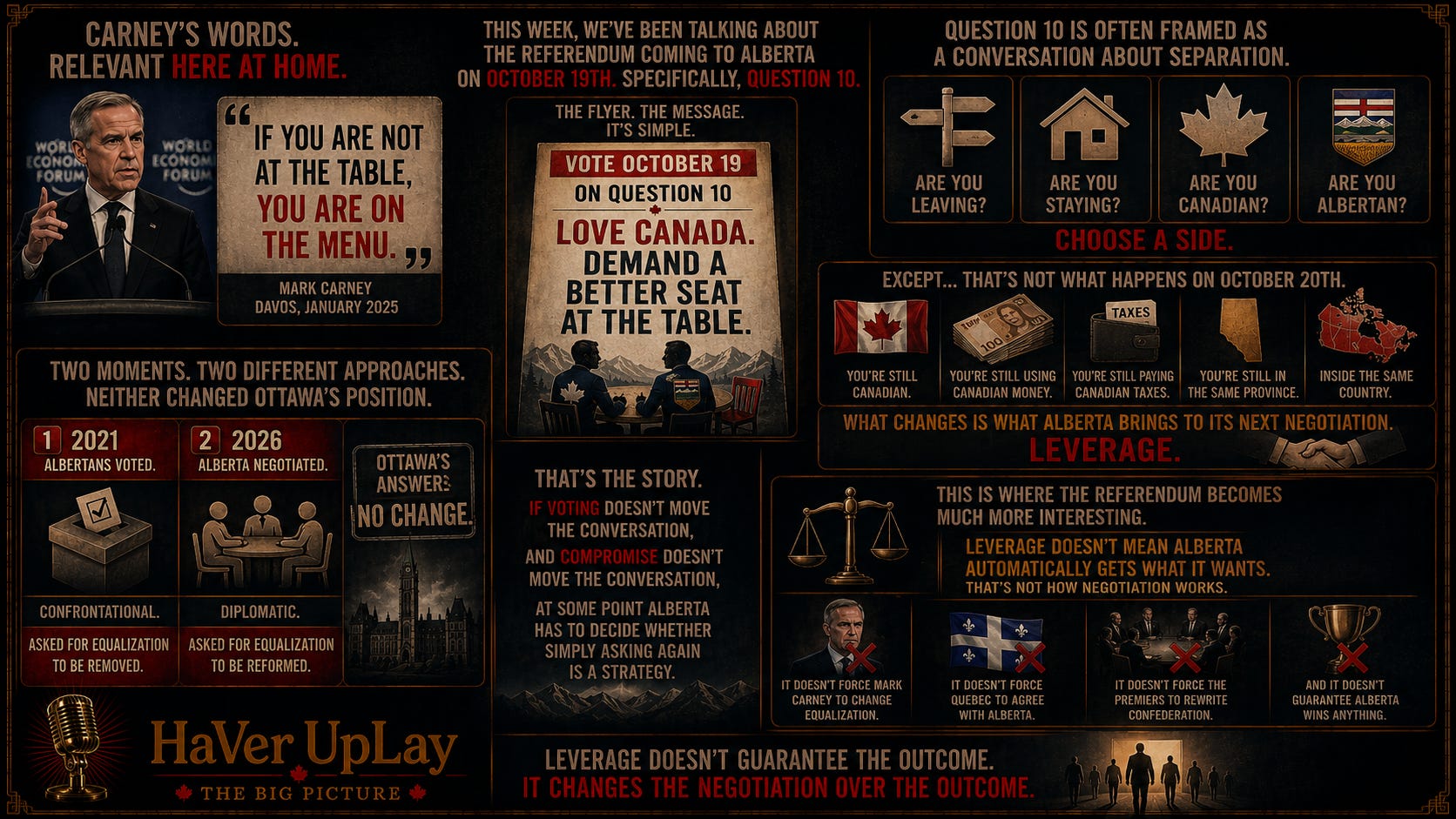
And that’s where Carney’s own words become particularly interesting here at home. Because we’ve spent the last week talking about the referendum coming to Alberta on October 19. And specifically, Question 10.
We’ve shown you the flyer now circulating throughout the province. And its message is remarkably simple. Love Canada. Demand a better seat at the table.
That’s important because Question 10 is almost immediately framed as a conversation about separation. Are you leaving? Are you staying? Are you Canadian? Are you Albertan? Choose a side. Except, that’s not what happens on October 20. We’ve already covered this. If Option 2 succeeds on October 19, Alberta doesn’t become independent the following morning. Nothing physically changes. You’re still Canadian. You’re still using Canadian money. You’re still paying Canadian taxes. You’re still living in the same province, inside the same country.
What changes is what Alberta brings to its next negotiation. Leverage.
And now we have an almost perfect example of why that distinction matters. Equalization. Forget the billions. Forget the formulas. Forget who receives what. For today’s conversation, you only need to remember two moments. 2021, Albertans voted. 2026, Alberta negotiated. Those are two very different approaches. One was confrontational. The other was diplomatic. One asked for equalization to be removed. The other asked for it to be reformed. And neither one changed Ottawa’s position.
That’s the story. Because if voting doesn’t move the conversation, and compromise doesn’t move the conversation, at some point Alberta has to decide whether simply asking again is a strategy.
And this is where the referendum becomes much more interesting. Because leverage doesn’t mean Alberta automatically gets what it wants. That’s not how negotiation works either. A successful Option 2 doesn’t force Mark Carney to change equalization. It doesn’t force Quebec to agree with Alberta. It doesn’t force the premiers to sit down and rewrite Confederation. And it doesn’t guarantee Alberta wins anything.
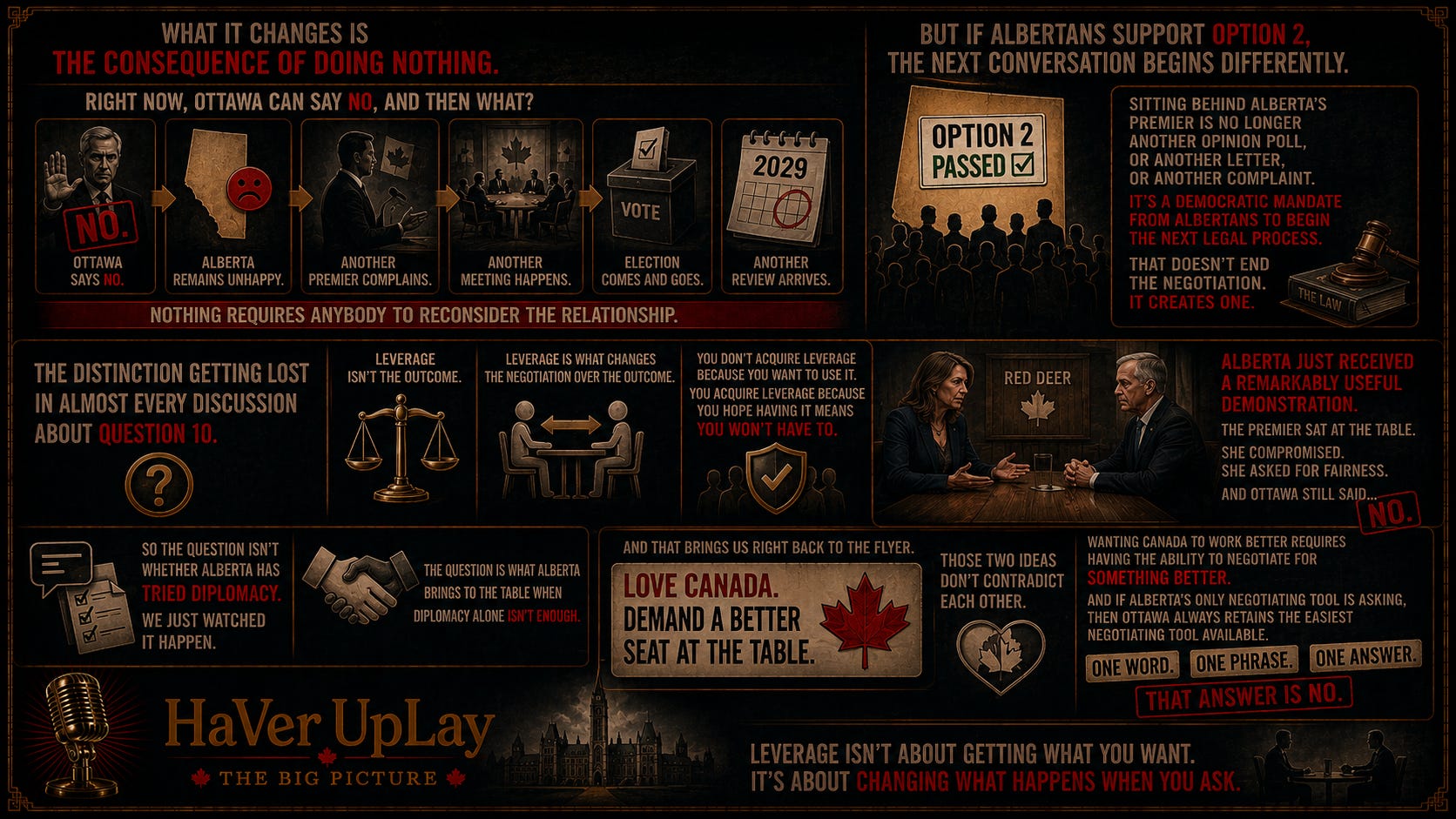
What it changes is the consequence of doing nothing. Right now, Ottawa can say no, and then what? Alberta remains unhappy. Another Premier complains. Another meeting happens. Another federal election comes and goes. Another review arrives. Nothing requires anybody to reconsider the relationship.
But if Albertans support Option 2, the next conversation begins differently. Because sitting behind Alberta’s Premier is no longer another opinion poll, or another letter, or another complaint. It’s a democratic mandate from Albertans to begin the next legal process. That doesn’t end the negotiation. It creates one.
And perhaps that’s the distinction getting lost in almost every discussion about Question 10. Leverage isn’t the outcome. Leverage is what changes the negotiation over the outcome. You don’t acquire leverage because you want to use it. You acquire leverage because you hope having it means you won’t have to. That’s how negotiations work.
And Alberta just received a remarkably useful demonstration. Because the Premier didn’t walk into Red Deer threatening separation. She didn’t demand the abolition of equalization. She didn’t flip the table. She sat at it. She compromised. She asked for fairness. And Ottawa still said no.
So the question isn’t whether Alberta has tried diplomacy. We just watched it happen. The question is what Alberta brings to the table when diplomacy alone isn’t enough.
And that brings us right back to the flyer. Love Canada. Demand a better seat at the table. Those two ideas don’t contradict each other. In fact, maybe this week’s equalization decision demonstrates exactly why they belong together. Because wanting Canada to work better requires having the ability to negotiate for something better. And if Alberta’s only negotiating tool is asking, then Ottawa always retains the easiest negotiating tool available. One word. One phrase. One answer. That answer is no.
Now. Here’s the Big Picture.
In 2021, Alberta asked. 61.7% voted for change. Nothing changed.
In 2026, Alberta asked again. This time, not for elimination. For compromise. For fairness. Ottawa’s answer? Not now. Wait until 2029.
Two attempts. Two different approaches. The same result.
And that brings us to October 19. Because Question 10 isn’t about waking up in a different country on October 20. It’s about what Alberta brings to the table the next time it asks.
A referendum didn’t move Ottawa. Diplomacy didn’t move Ottawa. Fairness didn’t move Ottawa. So Albertans are now being asked whether the next conversation should include something Alberta hasn’t brought before. Leverage.
Mark Carney said it himself. If you’re not at the table, you’re on the menu.
Alberta has been asking for a better seat. Ottawa has answered. On October 19, Albertans decide whether asking is still enough. Or whether it’s finally time to be off the menu and bring some leverage to the table.

Enough asking, talking and or begging. Time for action is now! Enough is enough..!
"There is a time when quiet courage and audacity become for a people at the key moments of its existence the only form of adequate caution. If it does not then accept the calculated risk of the great steps, it can miss its career forever, exactly like the man who is afraid of life." - Rene Levesque